
Monday, March 26, 2012
Blog Banner
If you're reading this, you'll notice instead of the boring old text we now have an awesome new banner for the blog! Credits to fellow Deviantart user, Itsgoose2u, for creating it. She did a great job!

Saturday, March 24, 2012
Happy Birthday
Happy 66th birthday to the first paleontologist I ever met, Robert T. Bakker! By the way, Bob, if you're reading this, I still remember Clepsydrops!
Thursday, March 22, 2012
Paleo Interview 4: Thomas Holtz, Jr.
As time goes on, something like a blog or a restaurant can get huge popularity if an important figure is seen there. That seems to be the case here - as I've been interviewing more and more famous people (though I don't see all these interviewees in a list of how important they are), I've seen more and more people reading and I thank the readers for that. With the exception of a few people (Greg Paul, David Peters, Jack Horner), I don't really see any paleontologist/paleoartist as more important than the other, but it is a great honor to have an interview with Dr. Thomas Holtz here today. Ever since he wrote his famous dinosaur encyclopedia, I've been a huge fan of his work and I finally got the chance to meet him a few weeks ago. I can still remember him walking by me and saying "Hi," and I was stuttering to say "Hi" back, but as soon I got to know him, I hit the conversation off easily and we chatted quite a bit, about Hell Creek dinosaurs, his book, documentaries, and some projects of mine. He's a great guy who is luckily patient enough to put up with my constant questions, and it's awesome to feature him on my blog. Enjoy.


First and foremost: read about ancient life! (Even easier now with the Internet!). And go to zoos and walk around in the wild: get to know how modern life works to help better understand the past.
-------------------------------------------------------------------------______
For anyone who still wants to learn more about Thomas Holtz, visit his website.
http://www.geol.umd.edu/~tholtz/


Holtz has seem to slain this giganotosaur.
----------------------------------------------------------------------
1. When did you first get interested in dinosaurs?
I have been interested since before I can remember. However, my parents tell me this story: when I was about three my parents bought me a plastic Tyrannosaurus or "Brontosaurus" (we can't recall which one was first), and they told me it was a dinosaur. Then a few weeks later they got me the other one, and told me it was a dinosaur. I apparently looked at them very skeptically, because how could these two animals that looked more different than horses look from cows have the same name? My mom didn't know the answer, but she came from a background in education, so she bought a copy of the How and Why Wonderbook of Dinosaurs and read to me from it. And from that moment I was hooked.
2. Did anyone in your life (family, teachers, etc) encourage your passion for dinosaurs?
Yes, my parents were very supportive of my interest. They got me dinosaur books from stores or the library; they took me to museums and other dinosaur sites; and so forth.
3. Did any paleontologist help encourage your career or inspire you?
Like a lot of people who grew up before the Dinosaur Renaissance, I looked to Roy Chapman Andrews and Mary Anning as inspirations, not realizing that neither of these actually were major researchers in dinosaur paleontology. When the 1975 "Dinosaur Renaissance" article by Bob Bakker came out in Scientific American, I was very influenced by that book, and by Adrian Desmond's The Hot-Blooded Dinosaurs. By the time I was in my teens I met the Smithsonian paleontologist Nick Hotton III.
After I was already in grad school and just afterwards, some of my main supporters were my advisor John Ostrom, Smithsonian paleontologist Michael Brett-Surman, and a group of great researchers who helped me along: Peter Dodson, Phil Currie, Peter Galton, Ralph Molnar, Dale Russell, and especially Jim Farlow.
4. What is your favorite memory having to do with paleontology (such as fossil digs, museum visits, etc)?
My favorite memory? That is a real tough one. I can't think of a single particular moment or event; rather, I am happy that I am now (and have been since the mid-1990s) been a person people come to for advice and information about dinosaurs. (My favorite moment eventually will be when some one names a dinosaur after me, but that hasn't happened yet.)
5. Have you ever named or help name any new dinosaurs?
 |
| This drawing shows two arctometatarslians. |
I have helped name a dinosaur who hasn't been published yet, so I can't give you the name. I named several groups of dinosaurs, however: Arctometatarsalia, Bullatosauria (no longer used); Maniraptoriformes; Eumaniraptora, Eusaurischia (with Kevin Padian & John Hutchinson).
6. Random mandatory question: What is your favorite paleoartist or piece of paleoart?
Tough one in terms of paleoartists, since there are so many good ones out there. But my favorite piece is easier: the Greg Paul piece of two Tyrannosaurus running away from the viewer (http://press.princeton.edu/
7. What did you think of the PaleoFest this year?
PaleoFest was awesome, and I definitely want to go back!

8. How was working on Dinosaur Revolution?
It was pretty fun! Much more interaction with the creative staff (animators, plotters, modelers, etc.) than other projects I've been on. There were some stories that were proposed that I am sad did not make it into the final version.
It was also the first time I had to do a lot of long-distance work via webcam, since most of the creative team is out in Los Angeles and I'm across the country.
9. What would you recommend for anyone interested in dinosaurs or any prehistoric creatures to do?
First and foremost: read about ancient life! (Even easier now with the Internet!). And go to zoos and walk around in the wild: get to know how modern life works to help better understand the past.
-------------------------------------------------------------------------______
For anyone who still wants to learn more about Thomas Holtz, visit his website.
http://www.geol.umd.edu/~tholtz/

The picture of Holtz and the above encyclopedia picture belong to Thomas Holtz and are from his website. Tyrannosaur drawing by me, the Tyrannosaurus by question 8 is property of the Dinosaur Revolution team.
Thursday, March 15, 2012
Paleo Interview 3: Stephen Brusatte
As all familiar readers should know, I always do interviews through email, and since I lack a webcam, and don't have car to drive everywhere to meet up with people, that seems to be the easiest way. This was the same with Stephen Brusatte. I met Brusatte two years ago at PaleoFest 2010, and I knew we talked quite a bit while we were there; I still remember jokes about him and how many books he's published and them betting how much we would have published by age 30. He has truly done quite a bit of stuff for his young age, so I decided to interview him. Enjoy.

----------------------------------------------------------------------------------------
I became interested in dinosaurs, and paleontology and evolution more broadly, right at about the same time I entered high school, so when I was about 14. I didn't really care about dinosaurs or fossils when I was a young kid, but my youngest brother did. He was going through the classic "dinosaur phase" when I was starting high school, and he asked me to help him out with a school project he was doing on dinosaurs. I wanted to be a good brother so I helped him go through his dinosaur books to gather information, and soon I became hooked! I was thrilled to learn about all of these strange types of dinosaurs that I have never heard of, and the new discoveries that were hitting the news. This was around 1998, so right around the time that the first feathered dinosaurs were discovered and published. Jurassic Park II had recently come out as well, so it was an exciting time to be learning about dinosaurs. I began reading as many websites as I could, and reading technical papers published by scientists. Within a few months I knew I wanted to be a paleontologist!
Definitely my brother, and also many of my science teachers. One teacher in particular, my high school geology teacher Joe Jakupcak, was a great mentor. He was the first person to take me out in the field and show me how to collect fossils, and then he taught me how to study and describe them. I did a research project in high school focused on the brachiopods and other invertebrate fossils found near where I grew up in central Illinois. It was a lot of fun and reinforced my goal of becoming a paleontologist, and Mr. Jakupcak was there to help me every step of the way. My entire family was also instrumental as well, not only my brother. My parents were always supportive: they would buy me dinosaur books, take me to the Field Museum and Burpee Museum all of the time, and even let me plan parts of summer vacations when we could visit dinosaur museums and field sites. I couldn't have become a paleontologist without them.
Paul Sereno was the most instrumental. I met Paul when I was in high school and began corresponding with him over email. He was really friendly and enthusiastic, and it just stunned me that such a famous scientist would respond to my questions! I decided to go to the University of Chicago to do my undergraduate degree and I began working in his lab soon after I started there. I eventually began working on research projects with Paul (we described three new species of carnivorous dinosaur from the Cretaceous of Africa, and I also assisted Paul in building databases to store taxonomic and phylogenetic data) and he took me to China and the western US to help him dig dinosaurs. I still can't believe how fortunate I was as an undergraduate--Paul was a great mentor and I will always appreciate all of the guidance he gave me. He helped mold me into a (hopefully) good scientist. And I still work with Paul today.
I've been really fortunate to do fieldwork in a lot of neat places (China, Portugal, Poland, Lithuania, England, etc.) and visit museums in North America, Asia, Europe, and South America. I've had a lot of adventures so far, and travel and adventure are some of the best perks of the job. If I had to pick one great memory it would be visiting the famous Cretaceous-Tertiary outcrops near Gubbio, Italy, where Walter Alvarez first discovered the "iridium anomaly" in the clay layer marking the Cretaceous-Paleocene boundary, when the dinosaurs went extinct. We went there on an undergraduate geology field course. In an amazing stroke of luck, Walter Alvarez was in Italy doing research at the time and he joined us in the field! He pointed out where he had first taken samples and explained to us how he first started to understand that an asteroid hit the earth at the end of the Cretaceous. I was hearing all of this directly, right from Dr. Alvarez, and it's a moment I'll never forget.
Yes, I have named some. Paul Sereno and I named Carcharodontosaurus iguidensis, Eocarcharia dinops, and Kryptops palaios, three large theropods from the Cretaceous of Africa, as well as the pygmy tyrannosaur Raptorex. With my current advisor (Mark Norell) I named the tyrannosaur Alioramus altai and the bizarre Romanian dromaeosaurid Balaur bondoc (also with colleagues Zoltan Csiki and Matyas Vremir from Romania). With a big team of scientists from China I named the carcharodontosaurid theropod Shaochilong maortuensis. I've also named some crocodiles, mammals, and other reptiles.
Well, this is a tough one to answer, because I have no artist talent whatsoever and I've never really tried my hand at paleoart! But, I've long respected people like Doug Henderson, Luis Rey, and Greg Paul, who bring dinosaurs to life through their amazing drawings and paintings. I'm also really blessed to work in New York alongside two excellent artists, Mick Ellison and Jason Brougham, and I worked in Chicago alongside Carol Abraczinskas, who does scientific illustration for Paul Sereno. I think their work really sets the standard for scientific illustration today.
We've learned many things, but the most important thing we've done is (gradually) build up a better and more complete family tree (phylogeny) of theropods, which better helps us understand how theropods have changed over their evolutionary history, how large body size evolved, and how the theropod skeleton changed as theropods evolved into birds. Maybe the neatest thing we've learned (not just through my work, but through the work of many theropod workers over the past couple decades) is that the evolution of birds was a gradual affair. Many characteristic features of living birds such as feathers and wishbones did not evolved together, did not evolve along with the origin of flight, and evolved millions of years before birds. These features are present in bona fide, non-flying theropod dinosaurs. That's an amazing story.
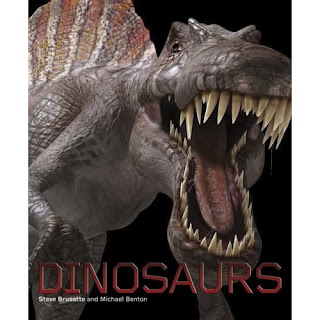
I really enjoy writing, both for scientific and popular audiences. My primary job is to write scientific papers--descriptions of dinosaurs and other fossils, as well as studies of evolution, aimed for other scientists. But I really love writing books for the public. I've done a few of these--Stately Fossils, Dinosaurs, and Field Guide to Dinosaurs. I wrote Stately Fossils about a decade ago and it was published by a good friend of mine, Lynne Clos, who runs the popular avocational fossil magazine Fossil News. The other two books are big, glossy, colorful coffee-table type books published by a London publisher called Quercus. Dinosaurs is meant for a more general audience, whereas the Field Guide is meant for young kids. Every month or so I get a random email from somebody (usually either a really young kid or their parents) who have read one of the books, and these messages really put a big smile on my face. I love it that I can help, even in a little way, to educate kids about science and nature. I have another book upcoming, called Dinosaur Paleobiology. It will be published by Wiley-Blackwell in April of this year. It is a technical book, meant for an audience of advanced students and fellow researchers. But, I hope it will also be useful for a more general audience of dinosaur fans and amateur fossil collectors. The aim of this book is to explain what we currently know about dinosaur anatomy, biology, and evolution, and the methods we use to gain this knowledge.

Always keep learning! The internet is a great resource, and there are so many websites and scientific papers freely available where you can learn anything you'd like about dinosaurs, fossils, and evolution. The best tool of any scientist is a flexible, inquisitive, and enthusiastic mind. And if you want to pursue a career in paleontology, be prepared to be patient! It takes a long time to get all of the necessary degrees (up to a PhD) that you need to get a job as a professor or museum curator. I'm still finishing my PhD, and will hopefully be done within the next year. If you do want to pursue a career in paleontology, it's important to take as many science, math, writing, and art classes as possible. All scientists need to understand the fundamental concepts of major scientific disciplines (chemistry, physics, geology, biology) and at least basic math and statistics. And all scientists need to be able to communicate their research effectively, so writing and art are critical as well. And most of all: just have fun. Work hard, and go wherever your interests take you.


Brusatte in Wyoming.
----------------------------------------------------------------------------------------
1. When did you first get interested in dinosaurs?
I became interested in dinosaurs, and paleontology and evolution more broadly, right at about the same time I entered high school, so when I was about 14. I didn't really care about dinosaurs or fossils when I was a young kid, but my youngest brother did. He was going through the classic "dinosaur phase" when I was starting high school, and he asked me to help him out with a school project he was doing on dinosaurs. I wanted to be a good brother so I helped him go through his dinosaur books to gather information, and soon I became hooked! I was thrilled to learn about all of these strange types of dinosaurs that I have never heard of, and the new discoveries that were hitting the news. This was around 1998, so right around the time that the first feathered dinosaurs were discovered and published. Jurassic Park II had recently come out as well, so it was an exciting time to be learning about dinosaurs. I began reading as many websites as I could, and reading technical papers published by scientists. Within a few months I knew I wanted to be a paleontologist!
2. Did anyone in your life (family, teachers, etc) encourage your passion for dinosaurs?
Definitely my brother, and also many of my science teachers. One teacher in particular, my high school geology teacher Joe Jakupcak, was a great mentor. He was the first person to take me out in the field and show me how to collect fossils, and then he taught me how to study and describe them. I did a research project in high school focused on the brachiopods and other invertebrate fossils found near where I grew up in central Illinois. It was a lot of fun and reinforced my goal of becoming a paleontologist, and Mr. Jakupcak was there to help me every step of the way. My entire family was also instrumental as well, not only my brother. My parents were always supportive: they would buy me dinosaur books, take me to the Field Museum and Burpee Museum all of the time, and even let me plan parts of summer vacations when we could visit dinosaur museums and field sites. I couldn't have become a paleontologist without them.
3. Did any paleontologist help encourage your career or inspire you?
Paul Sereno was the most instrumental. I met Paul when I was in high school and began corresponding with him over email. He was really friendly and enthusiastic, and it just stunned me that such a famous scientist would respond to my questions! I decided to go to the University of Chicago to do my undergraduate degree and I began working in his lab soon after I started there. I eventually began working on research projects with Paul (we described three new species of carnivorous dinosaur from the Cretaceous of Africa, and I also assisted Paul in building databases to store taxonomic and phylogenetic data) and he took me to China and the western US to help him dig dinosaurs. I still can't believe how fortunate I was as an undergraduate--Paul was a great mentor and I will always appreciate all of the guidance he gave me. He helped mold me into a (hopefully) good scientist. And I still work with Paul today.
4. What is your favorite memory having to do with paleontology (such as fossil digs, museum visits, etc)?
I've been really fortunate to do fieldwork in a lot of neat places (China, Portugal, Poland, Lithuania, England, etc.) and visit museums in North America, Asia, Europe, and South America. I've had a lot of adventures so far, and travel and adventure are some of the best perks of the job. If I had to pick one great memory it would be visiting the famous Cretaceous-Tertiary outcrops near Gubbio, Italy, where Walter Alvarez first discovered the "iridium anomaly" in the clay layer marking the Cretaceous-Paleocene boundary, when the dinosaurs went extinct. We went there on an undergraduate geology field course. In an amazing stroke of luck, Walter Alvarez was in Italy doing research at the time and he joined us in the field! He pointed out where he had first taken samples and explained to us how he first started to understand that an asteroid hit the earth at the end of the Cretaceous. I was hearing all of this directly, right from Dr. Alvarez, and it's a moment I'll never forget.
5. Have you ever named or help name any new dinosaurs?

Yes, I have named some. Paul Sereno and I named Carcharodontosaurus iguidensis, Eocarcharia dinops, and Kryptops palaios, three large theropods from the Cretaceous of Africa, as well as the pygmy tyrannosaur Raptorex. With my current advisor (Mark Norell) I named the tyrannosaur Alioramus altai and the bizarre Romanian dromaeosaurid Balaur bondoc (also with colleagues Zoltan Csiki and Matyas Vremir from Romania). With a big team of scientists from China I named the carcharodontosaurid theropod Shaochilong maortuensis. I've also named some crocodiles, mammals, and other reptiles.
6. Random mandatory question: What is your favorite paleoartist or piece of paleoart?
Well, this is a tough one to answer, because I have no artist talent whatsoever and I've never really tried my hand at paleoart! But, I've long respected people like Doug Henderson, Luis Rey, and Greg Paul, who bring dinosaurs to life through their amazing drawings and paintings. I'm also really blessed to work in New York alongside two excellent artists, Mick Ellison and Jason Brougham, and I worked in Chicago alongside Carol Abraczinskas, who does scientific illustration for Paul Sereno. I think their work really sets the standard for scientific illustration today.
7. What has your research in theropods told you?
We've learned many things, but the most important thing we've done is (gradually) build up a better and more complete family tree (phylogeny) of theropods, which better helps us understand how theropods have changed over their evolutionary history, how large body size evolved, and how the theropod skeleton changed as theropods evolved into birds. Maybe the neatest thing we've learned (not just through my work, but through the work of many theropod workers over the past couple decades) is that the evolution of birds was a gradual affair. Many characteristic features of living birds such as feathers and wishbones did not evolved together, did not evolve along with the origin of flight, and evolved millions of years before birds. These features are present in bona fide, non-flying theropod dinosaurs. That's an amazing story.

8. You've seen to written quite a few books and another one of yours is soon to be published. Can you tell the blog readers a little bit about it?
I really enjoy writing, both for scientific and popular audiences. My primary job is to write scientific papers--descriptions of dinosaurs and other fossils, as well as studies of evolution, aimed for other scientists. But I really love writing books for the public. I've done a few of these--Stately Fossils, Dinosaurs, and Field Guide to Dinosaurs. I wrote Stately Fossils about a decade ago and it was published by a good friend of mine, Lynne Clos, who runs the popular avocational fossil magazine Fossil News. The other two books are big, glossy, colorful coffee-table type books published by a London publisher called Quercus. Dinosaurs is meant for a more general audience, whereas the Field Guide is meant for young kids. Every month or so I get a random email from somebody (usually either a really young kid or their parents) who have read one of the books, and these messages really put a big smile on my face. I love it that I can help, even in a little way, to educate kids about science and nature. I have another book upcoming, called Dinosaur Paleobiology. It will be published by Wiley-Blackwell in April of this year. It is a technical book, meant for an audience of advanced students and fellow researchers. But, I hope it will also be useful for a more general audience of dinosaur fans and amateur fossil collectors. The aim of this book is to explain what we currently know about dinosaur anatomy, biology, and evolution, and the methods we use to gain this knowledge.

9. What would you recommend for anyone interested in dinosaurs or any prehistoric creatures to do?
Always keep learning! The internet is a great resource, and there are so many websites and scientific papers freely available where you can learn anything you'd like about dinosaurs, fossils, and evolution. The best tool of any scientist is a flexible, inquisitive, and enthusiastic mind. And if you want to pursue a career in paleontology, be prepared to be patient! It takes a long time to get all of the necessary degrees (up to a PhD) that you need to get a job as a professor or museum curator. I'm still finishing my PhD, and will hopefully be done within the next year. If you do want to pursue a career in paleontology, it's important to take as many science, math, writing, and art classes as possible. All scientists need to understand the fundamental concepts of major scientific disciplines (chemistry, physics, geology, biology) and at least basic math and statistics. And all scientists need to be able to communicate their research effectively, so writing and art are critical as well. And most of all: just have fun. Work hard, and go wherever your interests take you.

Brusatte with an egg in Barcelona. At least, I hope it's an egg. Oh God, I hope I'm not wrong.
-------------------------------------------------------------------------
For more info on Brusatte, visit his webpage:
IIf you have any questions for Steve Brusatte, make sure to email him. He's quick to reply and is a pretty friendly guy. Brusatte also writes articles for Prehistoric Times, so make sure to watch out for those too. Thanks for reading.

Images from Brusatte's website and property of Brusatte.
Wednesday, March 14, 2012
Wikipedia
I hope it's not really weird I got really excited when Gorgosaurus was the featured article on Wikipedia....
Sunday, March 4, 2012
PaleoFest 2012 - Day 2
Today we launched into the 2nd and sadly the final day of the outstanding PaleoFest at Burpee Museum in Rockford, IL. Some of the speakers today aren't as well known as others, but that didn't stop their lectures from being great.
Our first lecture, at 10:15AM, was titled "The Paleontology of Sid the Sloth", with Robert McAfee, a self-described "slothologist", who was very entertaining with his humor. The main point of the lecture, besides all the other stuff he was filling our brains with that I never even knew before, just what in heck is Sid? What genus, what species is he? Basing off of his seen diet, his features, size, etc, McAfee said Sid is a Nothrotheriops shastensis, with some Megalonyx-like tendencies, given some artistic license with the incisors. McAfee answered a question of mine that's been rattling in my brain; what was the body covering of the supermega sloths (as I tend to call them)? Shaggy fur? Elephantine skin? McAfee mentioned how he thinks it was possible for the supergiants, like Megatherium or Eremotherium to have a shaggy coat, depending on where they lived; the ones in Argentina and Canada, he said, would most definitely have this coat.
We stayed at our next lecture until about the 45-minute mark. Hosted by Fred Smith, we learned in-depth about Neanderthals (Neandertals, if you roll that way), Homo sapiens neanderthalensis (or Homo neanderthalensis if you roll that way). Smith did a good job explaining the differences between humans and Neanderthals, and also stressed the fact that Neanderthals just are NOT dumb, a stereotype that I particularly hate. At 12:20, we had to roll out and grab some lunch real quick. Why?
We were attending Scott Sampson's kids lecture at the Women's Centre. Yeah, kill me, I attended a kid's lecture. Look, I just wanted to meet Sampson. That's all. Despite the fact it was a kid's lecture, it wasn't near "dumbed"-down as some would think, and it reminded me of myself when I was a little 4 year old, having a conversation with Bob Bakker like I was his colleague. After the lecture, I slipped out of the room to be first-in-line, so he could sign my journal. I also gave him a drawing I did with my autograph and I think he took my pencil by accident. :P Ah well. After briefly speaking to him, I slipped back into the auditorium and watched for a little bit a documentary on Jane the Rockford T. rex, and then we headed back to the museum a little bit after 2:00.
Given our next lecture was at 3:30, we had quite a bit of time to kill. We headed up to the third level to see the new Neanderthal exhibit and back down to the coal forest, where I keep noticing new things. When we went back down to Homer's realm, we watched a girl (apparently, her name is Sam, something I only figured out right before writing this) drawing a standoff between a pair of Albertosaurus and Edmontonia. She told us about her technique and what she does and thanked her for her tips. We headed back upstairs, for no particular reason that I can remember, and ran into a volunteer working a table near the Jane exhibition. We hit him up talking about art as well, and then he headed back downstairs to talk to Sam. Around lecture time, we headed downstairs again, and ran into Sam again, as well as the guy from earlier and then another guy, who I later figured out, was apparently a fellow member from The Paleo Handbook! We talked and shared art for quite a bit, and I almost didn't make it to the lecture in time! Their deviantart accounts are below by the way:
Our final lecture was about the sabertooth cats, more specifically Xenosmilus and the scimitar cats. Virginia Naples, our speaker, had a lot to say about the anatomy of Xenosmilus, and how the different cats - dirktooth, scimitar tooth, cookie-cutter tooth, and conical tooth cats, hunted and occupied different niches. Apparently, Homotherium would run its prey down, while Smilodon and Xenosmilus were solitary ambush hunters. I learned a lot about the anatomy of cats and how they would have attacked. Fun fact: Xenosmilus are good tennis players.
Sadly, that last lecture closed up another PaleoFest. We still had fun though, especially after the lecture, where I and my dad, who has been living in the same town for fifty years, found out that our own little town actually had a fossil formations, yielding invertebrates from Ordovician deposits. We had some of these fossils, by the way, and as the woman who helped identify them, was looking some stuff up, we got to actually step foot in the lab. It was really cool seeing all the fossils, models, and posters (which I noticed a poster from Peabody calling a Pteranodon a Rhamphorhynchus) inside the lab, and even though huge windows look into the lab, I don't think I should share all that's going on in there. Suspense and tantalizing wonder for you. We swung by Michael's afterward and got some art supplies, then headed home. This is all thanks to Burpee Museum, which is the ONLY museum in North America that presents this opportunity. Check out their website and visit some time.
Saturday, March 3, 2012
Paleofest 2012 - Day 1
Well, it's been a long day, I've been up since 8:30AM (early for me) with on/off sleep, and even though I'm worn out, I'm posting this for you. That's my daily sacrifice. Enjoy. :)
It seems every year that Paleofest keeps getting better and that held true for 2012, the 14th annual Paleofest, of which I have attended eight. Many big names were there, but I'll go in chronological order.
The first lecture we attended was one on the Hot Springs of South Dakota, USA, hosted by Dr. Larry Agenbroad, who shared how they started and what they have found. The site was yielded 84 species of wildlife, including their famous mammoths, such as "Napoleon Bone-Apart", an oxymoron apparently, "Winston", and "Murray Antoinette". Camels, llamas, short-faced bears, wolves, and many more have been discovered. The lecture was interesting and revealed several different facts I previously did not know, considering I'm more of a dinosaur expert. For example, all the mammoths known at Hot Springs are male and 87% of them range from ages 12-29. Another interesting fact: woolly mammoths have longer tusks because they would have apparently used them less, then say, Columbian mammoths, which often suffered from broken tusks.
The 2nd lecture was the one I looked forward to most, for it was hosted by the legendary Thomas R. Holtz, Jr. His lecture about carnivorous dinosaurs was entertaining, especially since like all of our speakers, he threw in a bunch of jokes and cartoons, mainly about tyrannosaurs, as well as Carney the Carnotaurus. Holtz said that they are two hunting methods we usually see in large carnivores - the bite and slice method, and then the puncture and pull method favored by the tyrannosaurs. I talked to Holtz several times throughout the day; if you ever get a chance to talk to him, do it. Holtz was very friendly and managed to withstand through all my questions and comments, such as me inquiring about the unnamed oviraptorosaurs featured in the illustrations of his book, and the Triebold caenagnathid (or elmisaurine, whichever rocks your boat, I personally prefer the latter but call them caenagnathids out of habit), and then wondering what working on Dinosaur Revolution was like. Dr. Holtz described it as "interesting, yet strange", considering he, a Maryland resident, had to contact through the other team members from LA, through Skype and how he was disappointed that some scenes didn't make the cut, including one about Iguanodon. He remarked there were going to be more ornithischian segments (which would be awesome) but due to a limited budget, the 6 hours was shrunk to 4 hours.
After a quick lunch of hot dogs, chips, and brownies, we headed back down to the lower level to our 2:00 lecture about the rise of modern amphibians, the speaker of which was Jason Anderson. Anderson is also an expert in early ichthyosaurs, which also would have been a definitely interesting lecture, considering the strangeness of early ichthyosaurs (seriously, just look up Shastasaurus or Utatsusaurus). Anderson explained about the temnospondyls and lepospondyls, and the ongoing controversy; did the lissamphibians rise from the former, the latter, or both? Gerobatrachus, a temnospondyl also known as the "Frogamander" shows several characteristics similar to frogs and salamanders today.
The next lecture was at 3:30, hosted by Lawrence Witmer. Scott Williams, the person in charge of all this, remarked how you can not watch a dinosaur documentary on Discovery Channel without seeing Witmer, Holtz, or Scott Sampson. Witmer discussed his "The Visible Dinosaur" project, where they're reconstructing soft tissues and muscles in dinosaurs, the poster child of which was Majungasaurus during the presentation. He informed of us of how they go about it, such as looking at modern relatives like crocodiles and birds, and scanning them in CT scans. Witmer's team has a Facebook account and Youtube channel, something for all of us to check into.
Besides the speakers, we ran into several other respectful names in the paleontology field. William Hammer was there again, and he shared with me, as well as Dr. Holtz, about some awesome finds he has unearthed that will be in the news in maybe another year. Which reminds me, Tyler Keillor, paleoartist who has previously been featured on this blog, confided in me some secret projects of his own, of animals soon to be in the press. Keep your eyes peeled. Matt Bonnan showed up again, discoverer of Aardonyx, and so did tomorrow's speakers, including featured speaker Scott Sampson, who signed my book. I'll talk about him more in-depth tomorrow when I attend his lecture.
Above all, I'd have to thank the Burpee Museum at Rockford for hosting this extraordinary event, and my father for taking me every year. Burpee Museum has a steadily growing collection; anyone in the area should know it's worth a visit.
It seems every year that Paleofest keeps getting better and that held true for 2012, the 14th annual Paleofest, of which I have attended eight. Many big names were there, but I'll go in chronological order.
The first lecture we attended was one on the Hot Springs of South Dakota, USA, hosted by Dr. Larry Agenbroad, who shared how they started and what they have found. The site was yielded 84 species of wildlife, including their famous mammoths, such as "Napoleon Bone-Apart", an oxymoron apparently, "Winston", and "Murray Antoinette". Camels, llamas, short-faced bears, wolves, and many more have been discovered. The lecture was interesting and revealed several different facts I previously did not know, considering I'm more of a dinosaur expert. For example, all the mammoths known at Hot Springs are male and 87% of them range from ages 12-29. Another interesting fact: woolly mammoths have longer tusks because they would have apparently used them less, then say, Columbian mammoths, which often suffered from broken tusks.
The 2nd lecture was the one I looked forward to most, for it was hosted by the legendary Thomas R. Holtz, Jr. His lecture about carnivorous dinosaurs was entertaining, especially since like all of our speakers, he threw in a bunch of jokes and cartoons, mainly about tyrannosaurs, as well as Carney the Carnotaurus. Holtz said that they are two hunting methods we usually see in large carnivores - the bite and slice method, and then the puncture and pull method favored by the tyrannosaurs. I talked to Holtz several times throughout the day; if you ever get a chance to talk to him, do it. Holtz was very friendly and managed to withstand through all my questions and comments, such as me inquiring about the unnamed oviraptorosaurs featured in the illustrations of his book, and the Triebold caenagnathid (or elmisaurine, whichever rocks your boat, I personally prefer the latter but call them caenagnathids out of habit), and then wondering what working on Dinosaur Revolution was like. Dr. Holtz described it as "interesting, yet strange", considering he, a Maryland resident, had to contact through the other team members from LA, through Skype and how he was disappointed that some scenes didn't make the cut, including one about Iguanodon. He remarked there were going to be more ornithischian segments (which would be awesome) but due to a limited budget, the 6 hours was shrunk to 4 hours.
After a quick lunch of hot dogs, chips, and brownies, we headed back down to the lower level to our 2:00 lecture about the rise of modern amphibians, the speaker of which was Jason Anderson. Anderson is also an expert in early ichthyosaurs, which also would have been a definitely interesting lecture, considering the strangeness of early ichthyosaurs (seriously, just look up Shastasaurus or Utatsusaurus). Anderson explained about the temnospondyls and lepospondyls, and the ongoing controversy; did the lissamphibians rise from the former, the latter, or both? Gerobatrachus, a temnospondyl also known as the "Frogamander" shows several characteristics similar to frogs and salamanders today.
The next lecture was at 3:30, hosted by Lawrence Witmer. Scott Williams, the person in charge of all this, remarked how you can not watch a dinosaur documentary on Discovery Channel without seeing Witmer, Holtz, or Scott Sampson. Witmer discussed his "The Visible Dinosaur" project, where they're reconstructing soft tissues and muscles in dinosaurs, the poster child of which was Majungasaurus during the presentation. He informed of us of how they go about it, such as looking at modern relatives like crocodiles and birds, and scanning them in CT scans. Witmer's team has a Facebook account and Youtube channel, something for all of us to check into.
Besides the speakers, we ran into several other respectful names in the paleontology field. William Hammer was there again, and he shared with me, as well as Dr. Holtz, about some awesome finds he has unearthed that will be in the news in maybe another year. Which reminds me, Tyler Keillor, paleoartist who has previously been featured on this blog, confided in me some secret projects of his own, of animals soon to be in the press. Keep your eyes peeled. Matt Bonnan showed up again, discoverer of Aardonyx, and so did tomorrow's speakers, including featured speaker Scott Sampson, who signed my book. I'll talk about him more in-depth tomorrow when I attend his lecture.
Above all, I'd have to thank the Burpee Museum at Rockford for hosting this extraordinary event, and my father for taking me every year. Burpee Museum has a steadily growing collection; anyone in the area should know it's worth a visit.
Friday, February 10, 2012
C-Rex's Art of the Week 2
Well, I guessed I sort of missed last week, so we'll trawl up some drawings from then too.


Some very specific tyrannosaurs; Jane, the feathered rex at the bottom chewing on her contemporary Homer, the Rockford Triceratops; Sue, the largest of the tyrannosaurs pictured; Stan the second from the back starting to develop his mature feathers; and the Devil T. rex with a healthy mane of an adult male. Probably my favorite drawing I've done in a while.


Top to bottom: Triceratops horridus, Centrosaurus apertus, Zuniceratops christopheri, and Coahuilaceratops magnucerna. Done at school.

A baby Deinonychus antirrhopus finds himself prey to a raptor's nightmare; a fatal infestation of mites. Based on bird mites.
Saturday, February 4, 2012
Paleo Interview 2: Tyler Keillor
Recently, I emailed another artist I knew, one who does sculptures, by the name of Tyler Keillor. Tyler is a great guy who I've been able to talk to (in person this time) a couple times, once at my "local" museum, then again at another museum in Lake County. We've been able to keep in touch through email ever since then, and I usually keep him updated on my art, just like he keeps me updated on his.


One of Keillor's most recent sculptures portrays Dryptosaurus. With feathers too!
1. When did you first get interested in dinosaurs?
I can remember watching the original "Land of the Lost" TV show in the 70's, when I was maybe 3 or 4 years old. For those who have never seen it, it had dinosaurs created both with stop-motion animation and hand puppets in other shots. Totally cheesy by today's standards; but to a little kid back then it was awesome. I also saw "The Last Dinosaur" on TV at about that time, a man-in-rubber-suit dinosaur movie that really captivated me at a young age. Living near Chicago, I was also fortunate to have been taken to the Field Museum on many occasions, where my main objective was always to see the dinosaurs, mummies, and shrunken heads! At a very early age - again 3 or 4 - I started trying to draw dinosaurs and monsters ( they went hand-in-hand in my mind, especially the dinosaur-like kaiju, or Japanese monsters, that I saw in shows like Specterman, Space Giants, Giant Robot, and Godzilla and Gamera films).
2. Do you ever draw inspiration from real life or other paleoartists in your sculptures?
I have to say that part of the reason I'm in this line of work owes back to my childhood fascination with the Charles Knight murals at the Field Museum. They used to sell postcards of these murals in the museum gift shop, and I would get these as souvenirs and study them back at home. Every artist is in some ways inspired by those who blazed the path. I of course was influenced in my own early drawings and imaginings by Knight's work, and many of the other iconic artists whose work I also saw in old books we had lying around the house: Rudolf Zallinger's murals, Zdenek Burian's copious paintings, even Rod Ruth's kids books and jigsaw puzzle paintings. Today, I still admire and study the historic works of veteran paleoartists, and the new work by current and emerging artists. I find it inspiring to see the great variety of styles and techniques used by artists today, and of course with paleoart there is so much room for an artist to put his or her own stamp of originality on a piece. This is part of why I like to look to nature for inspiration: it allows a great deal of fascinating research in comparative anatomy, and the opportunity to find ways of adding reality-based details to speculative reconstructions. Starting with the real anatomy of a fossil, and bringing the creature back to life not by copying what other artists have done but by doing one's own research into why the animal may have looked a particular way, is for me a very rewarding part of the process.
3. Who is your favorite paleoartist?
I don't have a current favorite paleoartist, though I'm continually impressed by some of the artwork I see submitted in Prehistoric Times magazine. I must say that I haven't spent a lot of time on Deviantart; however after your recent blog post interview with Julio Lacerda, I spent some time in his and several others' galleries, and again I'm thoroughly impressed (and motivated to up my own game!). As I mentioned Charles Knight was probably my first favorite paleoartist, and then when I saw Zdenek Burian's work reproduced in books in my school library - especially some of his primitive man paintings - I thought I was looking at magical photographs of the ancient past! So he was a favorite for a while, too. When I became serious about trying my own hand at paleoart, I immersed myself in the works of the current professional practitioners, and they've all inspired me for different reasons.
4. What is your favorite sculpture you've done?
I'm pretty excited about the most recent sculpture I've created, which as of this posting hasn't been unveiled yet...so I'm bound to not give it away yet! I'll send you an update and some images as soon as this little ornithischian hits the press...
It's usually the case that my current project becomes my new favorite, as I try to incorporate all the tricks and techniques that I've used and developed on previous models in an effort to keep improving. Looking back, one highlight was myRugops primus sculpture in 2004. This was both my first life-sized flesh head, and also my first serious jump into comparative anatomical observations. I spent a lot of time researching what the different areas of Rugops' face should look like, and this involved trips to the herpetology and ornithology collection areas at the Field Museum. It was so exciting to compare the maxilla of Rugops and find similar textures on the skull of a cassowary - that guided my choice for creating the appearance of keratinous tissue, and was just the tip of the iceberg for many other extant observations. In retrospect I'd do a few things differently on the model today (such as the details of the oral margin), but I'm still happy with it. TheNigersaurus skull reconstruction and flesh model were also very challenging and exciting projects to work on, and I'm happy with the results. A funny thing about working with a deadline on these projects is that I never quite feel like I had enough time to really get it "right"; I think this is something most artists feel at times, when they're never quite satisfied with a piece, but still must call it "done" and move on to the next project.
It's usually the case that my current project becomes my new favorite, as I try to incorporate all the tricks and techniques that I've used and developed on previous models in an effort to keep improving. Looking back, one highlight was myRugops primus sculpture in 2004. This was both my first life-sized flesh head, and also my first serious jump into comparative anatomical observations. I spent a lot of time researching what the different areas of Rugops' face should look like, and this involved trips to the herpetology and ornithology collection areas at the Field Museum. It was so exciting to compare the maxilla of Rugops and find similar textures on the skull of a cassowary - that guided my choice for creating the appearance of keratinous tissue, and was just the tip of the iceberg for many other extant observations. In retrospect I'd do a few things differently on the model today (such as the details of the oral margin), but I'm still happy with it. TheNigersaurus skull reconstruction and flesh model were also very challenging and exciting projects to work on, and I'm happy with the results. A funny thing about working with a deadline on these projects is that I never quite feel like I had enough time to really get it "right"; I think this is something most artists feel at times, when they're never quite satisfied with a piece, but still must call it "done" and move on to the next project.

Rugops in the big old outdoors.

An interesting view of Tyler's Nigersaurus, about to munch down on some plants. I've been able to view the sculpture before, revealing some interesting details; a keratinous mixture and pieces of foliage and saliva in its mouth.
5. What is your favorite piece of art another paleoartist has done?
Recently I was blown away by the life-sized Spinosaurus sculpture created in Italy by the team from Geomodel. I don't know the artist(s) involved, but from the photos I've seen online, the model has a wonderfully natural scale pattern and coloration that I really love. A few other recent favorites include: David Krentz and team's digital creations for "Dinosaur Revolution", Hall Train's mechanical walking T-rex skeleton, John Gurche's hominids, I could go on and on!
6. Has anyone in your life ever played a role in your art and sculptures, encouraged you to pursue it, etc?
Both of my parents played a big role in starting me off and encouraging my work. My mom is an artist, so I grew up assuming it was natural that you should always have supplies and materials and a work-space to make anything you could imagine. When "The Dark Crystal" came out in 1982, my 10 year old mind was blown away - I was completely enamored by the artistry and creativity throughout that movie. My mom sculpted elaborate paper mache figures of characters Aughra and a Skeksis for me (which I still have!) and these creations showed me that it was possible to render tangible the fantastical. My dad helped me make a Super 8mm silent dinosaur film when I was about the same age, using rubber toys from my collection, and even the Skeksis my mom had made (minus his robes) doubled as a theropod in one shot! As I mentioned, movie monsters went hand-in-hand with dinosaurs for me, so my dad began to foster my interest in movie special effects by finding molding and casting supplies for me when I was in junior high school, and we would do experiments together like molding a hand with plaster and casting it in rubber. My parents let me take over a section of their basement to set up a workshop, doing all kinds of crazy experiments and learning about materials and techniques by trial and error. All of this laid the groundwork for the skills I would use in jobs to come.
Much later, I received another major vote of support when I met John Lanzendorf. If you've been to the Indianapolis Children's Museum, you may have seen his collection of Paleoart on display there in his own gallery. Prior to this, that art collection occupied every available space in his Chicago apartment. The Field Museum had a temporary exhibit with hisT-rex collection on display in 2000 (when Sue was unveiled). That's when I met John and we became friends. I showed him some of my work, and he was so supportive and urged me to keep improving, to meet other paleoartists, to join the Society of Vertebrate Paleontology, to meet other paleontologists... he really opened a lot of doors for me, and for many other artists, as well, during that chapter of his life. (Incidentally, if you're interested in John and his collection there was a very nice book about it called "Dinosaur Imagery: the science of lost worlds and Jurassic art: the Lanzendorf collection").
I also have to thank some great paleoartists I've been fortunate to get to know more recently. Mike Skrepnick, Gary Staab, Mark Hallett, and Donna Braginetz have all been very encouraging and supportive of my work, generous with advice, and sharing in information and shop-talk.
Much later, I received another major vote of support when I met John Lanzendorf. If you've been to the Indianapolis Children's Museum, you may have seen his collection of Paleoart on display there in his own gallery. Prior to this, that art collection occupied every available space in his Chicago apartment. The Field Museum had a temporary exhibit with hisT-rex collection on display in 2000 (when Sue was unveiled). That's when I met John and we became friends. I showed him some of my work, and he was so supportive and urged me to keep improving, to meet other paleoartists, to join the Society of Vertebrate Paleontology, to meet other paleontologists... he really opened a lot of doors for me, and for many other artists, as well, during that chapter of his life. (Incidentally, if you're interested in John and his collection there was a very nice book about it called "Dinosaur Imagery: the science of lost worlds and Jurassic art: the Lanzendorf collection").
I also have to thank some great paleoartists I've been fortunate to get to know more recently. Mike Skrepnick, Gary Staab, Mark Hallett, and Donna Braginetz have all been very encouraging and supportive of my work, generous with advice, and sharing in information and shop-talk.
7. How long does it usually take to finish a sculpture?
It can take a month or more to make one of my life-sized flesh-head sculptures. If my job is to start by creating a skull restoration, that might take a month or more itself, and then the flesh model over top of it might take another similar period of time. Sometimes I'll have more extensive pre-production time, when I'm making prototypes and collaborating with the researcher(s) on their discovery to determine what the final model should look like. Due to the uncertainties of reconstructing incomplete fossils while the paleontologists who found them are still actively cleaning and studying them, my work on Tiktaalik stretched on for about 6 months; my work on Sanajeh spanned about a year and a half!

The Tiktaalik sculpture appears to have a smile.

Tyler's representation of Sanajeh is one of my favorite of his sculptures. This baby titanosaur is about to become a snack.
8. What details do you include on your sculptures and how do you do it?
The details I put on my models are attempts at replicating the textures, tissues, details that I observe in my comparative references. For example, the keratin on top of Jane the juvenile tyrannosaur's snout is based in part upon a hornbill's cracked, weathering crest. I work with clay, so I use a variety of tools to carve lines, create folds, imprint textures that I've peeled off of other surfaces, etc. Then I go through the molding and casting process so that I can make durable, lightweight copies of the original clay model. After I've painted the cast, I have another opportunity to add details: strands of saliva within the mouth, bits of chopped vegetation in an herbivores mouth or chunks of "meat" lodged between the teeth of theropods, dirty peeling scabs, whatever else I can think of to give the creature a bit of life. I like to experiment with new materials (resins, rubbers, etc.) to figure out ways of recreating surfaces and textures I see in nature.
9. Anything you would like to say to anyone interested in dinosaurs or art?
I just think it's worth reminding ourselves how lucky we are to live at a time when dinosaur discoveries are being made all over the world at a record pace, research and technology is allowing a greater understanding of ancient life than ever before, and we have so many capable artists out there giving us wonderful glimpses of these amazing creatures. For anyone who wants to learn more or try creating some paleoart themselves, there is just no shortage of interesting subjects, or inspiring artists to look up to and learn from.
---------------------------------------------------------------------------------------------
For anyone interested in more of Tyler's work, visit his website:
Or watch his Youtube channel:

Jane the Rockford T. rex, whom I will see in March, would like to say bye.
An Observation on T. rex
Not that I just found this out, but it is something I noticed; T. rex must have hunted some of the most dangerous prey ever.
-The main two ceratopsians of Hell Creek, Triceratops horridus and Torosaurus latus, each must have weighed anywhere from 5-12 tons in weight, and were armed with three horns that could prove some damage, even when its impossible for them to charge without killing themselves. They also possessed crocodilian-like armour on their flanks and might have had quills as well, which may have been used for defensive measures like porcupines. They also had bone-crunching beaks suitable for snapping more than tough plants. The other ceratopsian, Leptoceratops gracilis, could prove a threat to young tyrannosaurs, with a large bite force, omnivorous diet, and possible quills too.
-The most common ornithopod at Hell Creek, Edmontosaurus annectens, could have weighed as much as T. rex, if not more, and a stampeding herd could easily crush the predator. I can picture subadults also bucking up and kicking like horses; if that's impossible, tell me so. Thescelosaurus neglectus could only pose a small threat, possibly even to young tyrannosaurs. Might have kicked and had quills.
-The other three known marginocephalians at Hell Creek are Pachycephalosaurus wyomingensis, Sphaerotholus buchholtzae and Stygimoloch spinifer (which I consider "Dracorex" as the juvenile form of). The latter two were only eight feet long at the most, but could have easily injured a juvenile tyrannosaur, using their domed heads and spikes to ward one off. The former genus is the largest pachycephalosaur known, with the largest forms around 20-25ft long, putting it in the same length class as Torosaurus. At this size, it could still pose a threat to a hunting tyrannosaur, probably capable of breaking some bones.
-More ornithischians are found in T. rex's range. These are the ankylosaurians, and the most famous is the widely-built Ankylosaurus magniventris, and it was nearly 30-35ft long and 13,000lb in weight. With thick armor, a clubbed tail (around 100lb, if I recall correctly), and ferocious tenacity, it would have been one of the hardest prey items available. Edmontonia schlessmani is found in T. rex's range as well, and although smaller than Ankylosaurus (20-25ft), it was armored, with well, armor, that included very long, sharp, shoulder spikes that would easily gore an attacker's skin.
-We usually don't think of theropods hunting other theropods, and think of them going after herbivorous creatures, but several theropod species were possibly prey of young tyrannosaurs. Struthiomimus sedens, 12-16ft long, would have been one of these, and it was built like an ostrich. Sadly, many people portray them, as well as duckbills, completely harmless, but this couldn't be the case. Like I said, built like an ostrich. Ostriches, and their much more dangerous cousin, cassowaries, can easily kill with one kick; Cracked.com states the ostrich kicking with the force of "2.5 Mike Tysons". An ostrich is on average around 215lbs, and when you scale it up onto a 330lb dinosaur, the damage won't be pretty.
-The other theropods that are possibly tyrannosaur prey are odd creatures; the oviraptorosaurs. Chirostenotes elegans was a 6-8ft long creature and could have kicked like an ostrich as well. I don't know much about the head strength of oviraptorosaurs, but they might have been able to bite pretty hard as well and ram with their crests, as well claw with their arms. The Triebold caegnathid, unnamed at the moment, was twice the size of the largest Chirostenotes, and would have posed even more of a threat.
-One more saurischian could have possible prey for T. rex, albeit not at Hell Creek, and a T. rex would have to be suicidal to attempt to hunt it alone. Alamosaurus sanjuanensis is the largest dinosaur known from North America (besides the extremely fragmentary Amphicoelias) and was Argentinosaurus-sized, placing it at 80-90 tons. T. rex would have had to hunt in packs to bring an adult down, and even then, it was still a danger.
-The main two ceratopsians of Hell Creek, Triceratops horridus and Torosaurus latus, each must have weighed anywhere from 5-12 tons in weight, and were armed with three horns that could prove some damage, even when its impossible for them to charge without killing themselves. They also possessed crocodilian-like armour on their flanks and might have had quills as well, which may have been used for defensive measures like porcupines. They also had bone-crunching beaks suitable for snapping more than tough plants. The other ceratopsian, Leptoceratops gracilis, could prove a threat to young tyrannosaurs, with a large bite force, omnivorous diet, and possible quills too.
-The most common ornithopod at Hell Creek, Edmontosaurus annectens, could have weighed as much as T. rex, if not more, and a stampeding herd could easily crush the predator. I can picture subadults also bucking up and kicking like horses; if that's impossible, tell me so. Thescelosaurus neglectus could only pose a small threat, possibly even to young tyrannosaurs. Might have kicked and had quills.
-The other three known marginocephalians at Hell Creek are Pachycephalosaurus wyomingensis, Sphaerotholus buchholtzae and Stygimoloch spinifer (which I consider "Dracorex" as the juvenile form of). The latter two were only eight feet long at the most, but could have easily injured a juvenile tyrannosaur, using their domed heads and spikes to ward one off. The former genus is the largest pachycephalosaur known, with the largest forms around 20-25ft long, putting it in the same length class as Torosaurus. At this size, it could still pose a threat to a hunting tyrannosaur, probably capable of breaking some bones.
-More ornithischians are found in T. rex's range. These are the ankylosaurians, and the most famous is the widely-built Ankylosaurus magniventris, and it was nearly 30-35ft long and 13,000lb in weight. With thick armor, a clubbed tail (around 100lb, if I recall correctly), and ferocious tenacity, it would have been one of the hardest prey items available. Edmontonia schlessmani is found in T. rex's range as well, and although smaller than Ankylosaurus (20-25ft), it was armored, with well, armor, that included very long, sharp, shoulder spikes that would easily gore an attacker's skin.
-We usually don't think of theropods hunting other theropods, and think of them going after herbivorous creatures, but several theropod species were possibly prey of young tyrannosaurs. Struthiomimus sedens, 12-16ft long, would have been one of these, and it was built like an ostrich. Sadly, many people portray them, as well as duckbills, completely harmless, but this couldn't be the case. Like I said, built like an ostrich. Ostriches, and their much more dangerous cousin, cassowaries, can easily kill with one kick; Cracked.com states the ostrich kicking with the force of "2.5 Mike Tysons". An ostrich is on average around 215lbs, and when you scale it up onto a 330lb dinosaur, the damage won't be pretty.
-The other theropods that are possibly tyrannosaur prey are odd creatures; the oviraptorosaurs. Chirostenotes elegans was a 6-8ft long creature and could have kicked like an ostrich as well. I don't know much about the head strength of oviraptorosaurs, but they might have been able to bite pretty hard as well and ram with their crests, as well claw with their arms. The Triebold caegnathid, unnamed at the moment, was twice the size of the largest Chirostenotes, and would have posed even more of a threat.
-One more saurischian could have possible prey for T. rex, albeit not at Hell Creek, and a T. rex would have to be suicidal to attempt to hunt it alone. Alamosaurus sanjuanensis is the largest dinosaur known from North America (besides the extremely fragmentary Amphicoelias) and was Argentinosaurus-sized, placing it at 80-90 tons. T. rex would have had to hunt in packs to bring an adult down, and even then, it was still a danger.
Subscribe to:
Posts (Atom)