Welcome to a blog now shared by one, two, um... four people. Wipe your shoes off on the mat and delve into the posts featuring rants, museum pictures, and some cool facts. Nerds of all kinds welcome.

Tuesday, May 15, 2012

Romanian Enantiornithes

Wonderful image by Julio Lacerda.

Another great theropod discovery for 2012! A nesting colony of Romanian enantiornithes (the diverse family that occupied many niches) was found in, well, Romania, where fossils have yielded such wonderful discoveries like Hatzegopteryx and Balaur, as well as Telmatosaurus. The cause of death? A flood is most likely. I also have to agree with Mr. Naish here when I say Julio seemed to reconstruct the enantiornithes to look like birds, not crazy feathered-dragon monsters. Oh yeah I found my new favorite word: dortokids. It's the family those turtles in the image belong to.

Sunday, May 13, 2012

Prehistoric Elephants

Recently I drew a Platybelodon and uploaded it to Deviantart, proclaiming my love for extinct elephants (and other afrotheres, and other "pachyderms"). So let's talk about elephants, shall we?
----------------------------------------------------------------------------------------------

Elephants, formally known as proboscideans, first appeared in the fossil record some 58.7 million years ago, in the late Paleocene. The first of the proboscideans known is named Eritherium and it was the size of a large rabbit (~5kg). Yeah, you heard the books call  Moeritherium small. The  slightly bigger (fox-sized) Phosphatherium followed about two million years later. Both of these tiny elephant ancestors hailed from Morocco, home of Casablanca. The amphibious anthracobunids followed next, and were probably ancestral to moeritherids and desmostylians, and possibly the sirenians. This family existed from the Early-Middle Eocene.

More proboscideans began to rise in the Eocene. One of these was the somewhat famous Moeritherium, the rotund little hippopotamus-niche filler. It is often stated as one of the earliest elephant genera, but has seen above, Eritherium came earlier before they were cool. Fellow proboscideans Phiomia and Palaeomastodon, the latter already similar to modern-day elephants coexisted with Moeritherium. Phiomia probably used its upper tusks to strip bark off trees, while Palaeomastodon is thought to have scooped water plants into its mouth. Also from the Late Eocene was Barytherium, which sported eight (though short and stubby) tusks. Showoff.

During the Oligocene, families were either diversifying or dying off. Brontotheres were part of the latter decision, as were embrithopods and multituberculates. As forests gave way to plains, horses, camels, rhinos, entelodonts, and oreodonts diversified. Elephants also diversified. By the late Oligocene, a bizarre family had sprouted up; the deinotheres. Chilgatherium was the earliest known deinothere,  the size of a small hippo. It is unknown if it had the bizarre downwards pointing tusks that makes the family famous and earns them the nickname "hoe-tuskers". Time went on, and in the middle Miocene, when Prodeinotherium died out, Deinotherium arose. This deinothere proved to be the most successful as it only went the way of the dodo in the Early Pleistocene. D. giganteum was one of the largest terrestrial mammals ever known, exceeded only by a few mammoths and the giant rhino Paratherium.


Equally as bizarre were the gomphotheres, a family from the Miocene to the Pleistocene eras. A very diverse family, they flourished and enjoyed ecological success. One of the most famous is the "shovel-tusker" Platybelodon, seen above. With tusks on its long lower jaws, and the typical tusks found on modern elephants, it is thought to have scraped bark off of trees and consume branches. There were other "shovel-tuskers" as well, such as Amebelodon and Archaeobelodon. Another somewhat well-known gomphothere was Anancus. Why? Just look to the upper right and you'll see why. It's those really long tusks that make it stand out. Yep, each tusks measures 13ft long, slightly longer than the elephant is tall. How's that for a trophy?

Another famous gomphothere is the one that gives the family its namesake. Gomphotherium, 10ft tall, sported four tusks and probably inhabited dry wooded regions by lakes, or perhaps swamps to boot. It was also one of the most successful gomphotheres as it spread into Afro-Eurasia, North America, and possibly South America (in Chile) as well. The last gomphothere we'll talk about is Cuvieronius, a 9ft tall elephant with spiral tusks. It is the most recent of the gomphotheres, dying out just 6,000 years ago. Named after George Cuvier, it has been found in the US, Mexico, and South America.

Now we touch on the most famous prehistoric elephants of all: mammoths and mastodons. While the former term is often used to describe something large in size, it technically defines anything that belongs to the genus Mammuthus. Of that genus, eleven species have been described: M. meridionalis, M. trogontherii, M. imperator, M. exilis, M. subplanifrons, M. africanavus, M. columbi, M. lamarmorae, M. hayi, M. creticus, and most famous of all, M. primigenius, the woolly mammoth. In common terms, that's, respectively: the southern, steppe, imperial, pygmy, African, North African, Columbian, Sardinian dwarf, (no common name), and the Cretan dwarf mammoths. Despite their large numbers, the mammoths existed in a short window of time, only 5 million years. Despite these numbers, there were able to inhabit Afro-Eurasia and North America, ranging in size from 3-17ft tall. The woolly mammoth isn't actually as "mammoth" as some may think, standing "only" 9ft tall, and when compared to the steppe and southern mammoths, it looks quite small.

Mastodons, known by the genus Mammut, are often confused with mammoths by laymen, by there are several differences. Mastodons were usually smaller and lacked the classic dome head, and had different dentition than mammoths. Seven species have been described in the genus: M. furlongi, M. matthewi, M. raki, M. spenceri, M. pentilicus, M. cosoensis, and the classic American mastodon M. americanum. It would have lived in spruce forests, as well as warmer lowlands, and it went extinct only 10,000 years ago.

All in all, elephants proved to be one of the most successful families in history, carrying on a legacy that has lasted for 55 million years. From the tiny Eritherium they blossomed into the five ton African elephant and became some of the largest terrestrial mammals.
-------------------------------------------------------------------------------
In respective order:


© Vladimir Nikolov.
© BBC and Impossible Pictures.
© Dmitry Bogdanov.
© Boris Dimitrov.
© Remy Bakker.
© Charles R. Knight.
© Mauricio Anton.
© Sergio De la Rosa Martinez.

Thursday, May 10, 2012

Birds of Prehistory, Part II

On occasion, I write articles for the birding group I belong to (Illinois Young Birders http://illinoisyoungbirders.org/), mostly about prehistoric birds or something like that. The next issue coming up features my article Birds of Prehistory Part 2 (Part 1 is in an earlier issue and is way less good than this one). Here's the text of the article for those who are interested:
---------------------------------------------------------------------------------
BIRDS OF PREHISTORY PART DOS
Quick, say ‘bird’. What’s the first thing that pops up in your mind? A sparrow? Gull? Ostrich? These forms may seem familiar today; we’ve all seen birds in the wild and in zoos, but before man there were much, much stranger birds that lived.
The Enantiornithes: Conquerors of the Mesozoic
            One of the most successful groups of birds that ever existed was the enantiornithes, which colonized the world of the dinosaurs for sixty six million years. If you’ve ever watched Walking with Dinosaurs, then you’ve most likely seen enantiornithes; the birds attacking the pterosaur (similar to hummingbirds and other birds which will attack hawks if they stray too close to their nests) were enantiornithes known as Iberomesornis. A small (finch-sized) bird, Iberomesornis inhabited what is now Spain nearly 125mya, living near rivers and deltas with oddities such as the dinosaur Pelecanimimus, which can be imagined as a flightless pelican, and the hump-backed Concavenator, a carnivore related to Allosaurus. Known as the “opposite birds”, due to the arrangement of the scapula/coracoid bones filled the niches that are inhabited by passerines, sapsuckers and raptors today. We’ve already talked about one in the first part of BOP, known as Avisaurus, which was like a red-tailed hawk with a meter-wide wingspan and teeth. A Chinese form, Longipteryx, would have filled the niche the kingfishers occupy today. However, all good things must come to an end, and even though the enantiornithes stormed through five of the world’s continents, they went extinct along with non-avian dinosaurs 65mya.
Killer Ducks and Seriemas: Birds Hold Their Grip
            The Cenozoic, the age we live in now, is often called the Age of the Mammals, due to the fact mammals were evolving more rapidly and taking over niches the non-avian dinosaurs left. Rhino-like uintatheres and brontotheres filled the niche that non-avian dinosaurs like Triceratops left behind; the cougar-like Patriofelis was the apex mammalian predator. But dinosaurs, in the form of birds, weren’t giving up just yet. For 16 million years, a 5-7ft tall bird terrorized North America and Europe. Known as Gastornis, this bird wasn’t large enough to take on the uintatheres that inhabited the land at the time, but they were large enough to kill just about anything else in their environments; pygmy horses in North America, anteater cousins in Europe, etc. They faced little competition from mammals, except for the aforementioned Patriofelis and the jackal-sized Arctocyon. And while Gastornis, an anseriforme, died out 40 million years ago and mammals took over, South America wasn’t ready for mammals’ rule yet.
            They came in the form of terror birds. When we went to the Field Museum, a model of one, Andalgalornis, was in the room where we saw the hawk. Terror birds reigned over South America for sixty million years, their rule ending just 2 million years ago. Related to seriemas (cariamas), they were apex predators, most of them nimble and agile, striking down prey with their sharp talons and beaks. Phorusrhacos, a Gastornis-sized terror bird, was anachronistically featured alongside sabertooth cats in Walking with Beasts. The largest terror birds were Titanis and Kelenken, 8ft and 10ft tall, respectively. The former actually reached North America and managed to cause terror (no pun intended) for another three million years, running alongside prey at speeds of 65 kph, rivaling that of the ostrich. And then, for unknown reasons (probably niche competition), they all died out, and were replaced by carnivores such as wolves and sabertooth cats.
Pseudodontorns: Pterosaurs Rise Again
            Seventy-five million years ago, a large pterosaur known as Pteranodon, soared over Kansas, when it was an interior sea, and dwelled on cliffs, consuming fish. Fifty-five million years later, a similar scene is repeated and the actors are birds. Known as the pseudodontorns, these birds are known in the fossil record from 58-2mya, with the most famous being Osteodontornis, which lived 20mya in North America. This bird had the second-largest wingspan in avian history, surpassed only by a giant South American vulture (bonus points if you know its name). The pseudodontorns were odd birds, with the largest possessing wingspans of twenty feet. They also had bills lined with false teeth (hence, their group name means ‘false tooth birds’), similar to the projections on mergansers’ bills. These giant birds would have filled the niche that some pterosaurs held in the Mesozoic era, and the niche albatrosses fill now. When they went extinct 2.5mya, Olduvai stone tools were just being invented.
Samrukia and Gargantuavis: Giant Birds of the Mesozoic
            Everyone knows the Mesozoic as the heyday of the non-avian dinosaurs. They reached immense sizes, so big that no other animal could get bigger than a rat when they were alive. But that view is inaccurate. In reality, mammals, birds, and reptiles flourished into various niches and sizes. Badger-sized mammals fed on baby dinosaurs, crocs the size of SUVs walked around on land and terrorized life. And even the birds were getting huge. On the islands of Late Cretaceous France, a bird as tall as man roamed. Possibly related to the patagopterids mentioned in Part 1, it was an herbivore, somewhat like a moa, and its name was Gargantuavis. But this wasn’t the only giant bird around, or so it is thought. Very recently discovered, the Kazakh Samrukia was a bird that must have stood 10ft tall. However, its classification is disputed at the moment. Since it is only known from a jawbone, some say it could be a pterosaur and some say it could be an oviraptorosaur dinosaur. Whatever the case is, it was gigantic, and proves that dinosaurs weren’t the only big ones around.
Presbyornis: The Flamingo-duck
We end this article on a peculiar bird that appeared just three million years after the non-avian dinosaurs were wiped out (and it could have possibly lived alongside the last dinosaurs, if scant fossil remains prove to be from it). Named Presbyornis, it was an early anseriform, which most professional birders would recognize as the order that includes ducks, geese, swans, screamers, and magpie geese. While an individual could weigh in at goose-swan size (14-33lbs), Presbyornis was much more gracile, with longer legs, standing around 3-5ft tall. In fact, it resembled a flamingo with the head of a dabbling duck, feeding on small animals and water plants. Presbyornis proved to be a successful design, living for seven million years before dying out. The author hopes you learned some new bird material from this article.

Sunday, May 6, 2012

Nature, You Scary!


Say hello to Crocodylus thorbjarnarsoni (try saying that 3x fast):

© HodariNundu. 

That's a frickin' Hippopotamus gorgops in its jaws by the way. At 27ft long, it was the biggest true crocodile ever known (creatures such as Sarcosuchus or Purrussaurus were bigger, but not true crocodiles) and it might have preyed on early hominins. Yeah, trying being neighbors with a crocodile big enough to star in Lake Placid. 


Thursday, May 3, 2012

Even Buttheads Get Boo-Boos


http://blogs.smithsonianmag.com/dinosaur/2012/05/fossil-testifies-to-pachycephalosaur-pain/

There's a lot of debates in paleontology. Is T. rex a scavenger? Are Triceratops and Torosaurus the same? Though the former is pretty famous to laymen and normal people, the particular debate we're talking about is one generally more known among people in the paleontology field. The debate is: did pachycephalosaurs butt heads? Well, a recent discovery might have the answer. Described as "it looked like someone went through it with a hammer", an injury in the skull dome of a Pachycephalosaurus shows that they most likely did, indeed, butt heads (you can hear your little siblings laughing at this already).

Monday, April 30, 2012

Thursday, April 26, 2012

Some More Theropods

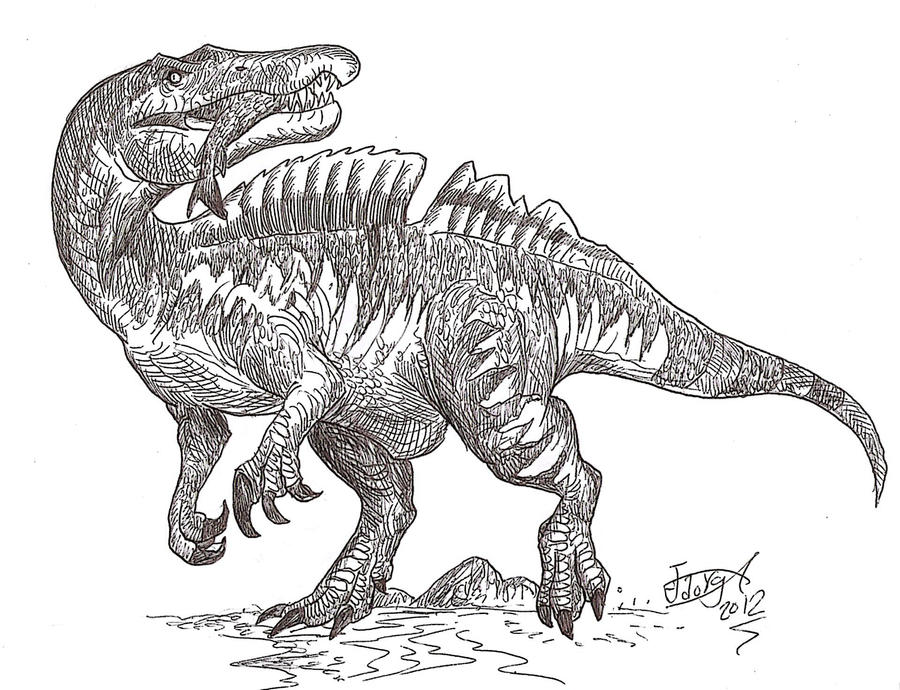
This year is so far proving to be a productive year for theropods. What, with the giant (ok, 8.5ft and 100lbs) alvarezsaur Bonapartenykus, the very recent Ichthyovenator (which I think now might have just had one sail and that the fossil has broken vertebrae), and the astonishing Yutyrannus, we've had some phenomenal discoveries. And this keeps happening. Our first theropod story is on that mysterious ornithomimosaur Deinocheirus, the giant one with sloth arms to disembowel you with. Apparently, some gastralia were found with the remains of a Tarbosaurus, showing its last meal. So, we got some new Deinocheirus material.

Also in breaking news is the fresh off the shelf Ostafrikasaurus, the earliest known spinosaur, dating back to Tendaguru rocks 148 million years old. Looks like those Bahariya giants can trace their history back longer than we thought. Also in the news, while not a theropod, an unusual 450-million year old fossil was found, 7ft long. Nicknamed "Godzillus" =  awesome name.

Wednesday, April 25, 2012

Some More Info on Spinosaurs

Looks like my blog was mentioned on LITCs newest post:

http://chasmosaurs.blogspot.com/2012/04/spinosaurids-arrive-in-asia.html

Pretty cool, though I had to beg like a sucker to get my blog in the list of links, ha ha.

Anyways, back to the point. If you read the post at LITC, David mentions a possible spinosaur phalanx (?) previously thought to be from Torvosaurus, the awesome theropod that terrorized the Morrison Formation (where the phalanx was found) and Portugal, as we all saw in Dinosaur Revolution. So, this means that spinosaurs had a potential reign (well, by bodies of water, I guess; the apex predator role was taken by carnosaurs and their cousins [spinosaurs] the megalosaurs) in a near-worldwide distribution. We now know they came from South America, Asia, Africa, and Europe. With possible, scarce remains in Australia, and the phalanx mentioned earlier before, this means they could have occupied six continents. With dinosaurs such as titanosaurs, ankylosaurs, and dromaeosaurs showing up in Antarctica, could it be possible spinosaurs continued their range there too? Interesting food for thought. For now, we'll just have to wait.

©Hyrotrioskjan


©Robinson Kunz


Monday, April 23, 2012

Ichthyovenator

A new spinosaur, Baryonyx-sized, has been discovered in the Laos, called Ichthyovenator laosensis (how convenient) and it had two sails (package deal). Already, I've had two things pop up in my Deviantwatch, maybe it'll start popping up even more frequently soon enough.

© HodariNundu. 2012. 

Identification Help


Does anyone know what these are. I think they might be fish scales, but I'm not too entirely sure. We found them by the river; the big one is about 2in tall, the other is 1in. They have a somewhat bony texture.