http://www.facebook.com/pages/Domain-of-the-C-Rex/543309825701842
Yes, the blog has invaded Facebook now. More likes please.

Monday, February 25, 2013

The Adorable Australian Pig-Nosed Flippered Freshwater Turtle

It's Day 2 of "Turtlemania" and that brings us to this little charmer right here: the pig-nosed turtle. It's also known as the Fly River turtle, but I think my title beats all of them: the adorable Australian pig-nosed flippered freshwater turtle. This turtle, Carettochelys insculpta, is the sole living member of the family Carettochelyidae, though several extinct members are known.

"Aww," says the human.
"My entire family is dead," says the turtle.
"Oh."
If you haven't deduced it by the images shown above, the pig-nosed turtle is truly bizarre. It combines characteristics of softshell, sea, and other freshwater turtles into some conglomerate superturtle. As made obvious by the name, the snout is pig-like and tubular, resembling the noses of the softshell turtles. They are also the only freshwater turtle to possess flippers, as like sea turtles. And the shell is similar to other freshwater turtles. They also have a permanent baby frown with a touch of smugness.

These goofy-looking turtles are found in Australia and New Guinea and are omnivorous, feeding on figs, leaves, and invertebrates. Just like snapping turtles, they are rather common in their range but have shown a decline in recent years. Below is a blurry clue for what's next.

Sunday, February 24, 2013
Snapping Turtles: Nature's Way of Saying Screw Off

Perhaps this is just coming from being the passionate owner of one, but turtles are another animal that always have a special spot in my heart (well technically my brain). They're such odd animals, and I hope to chronicle them over the next few days. And what's a better way to start than snapping turtles, my own seen above?

Those who have been familiar with this blog for some time now might recognise the photo above: it's an alligator snapping turtle photo I captured at Serpent Safari in Gurnee. Alligator snapping turtles are one of the two main kinds of "snappers". Alligator snapping turtles are the largest of the modern genera, bigger than even the Arrau turtle of South America. Found primarily in the Southeast US, they can also be found in parts of the Midwest. These huge turtles (some reaching 250lbs) are opportunistic carnivores, taking many species of animals, alive or dead. Fish, molluscs, carrion, and amphibians forms the majority of their diet, but they also prey on rodents, other reptiles, worms, and even some aquatic plants. They're even tough enough to devour the babies of the largest reptile in the US: the American alligator. And toughness brings us to our next turtle.

Common snapping turtles have no conception of size whatsoever. Lions will often back down from elephants and giraffes, wolves sometimes won't approach moose, and even crocodiles often don't attack the biggest prey. Common "snappers" on the other hand, go after anything. What they lack in size (weighing "only" 35lbs on average) they make up for in ferocity, often launching themselves and snapping at any opponent, often in a rhythmic repeat. My own often tries to snap at me during feeding time. As the name suggests, they are widespread across the US. Not even Central and South America are safe from the scourge, each having their own species of "snapper".

And we know not even prehistoric times were safe from snapping turtles. Hell Creek had these (now just picture a T. rex with its toes caught in a snapper's mouth), alligator snapping turtles have been around since the Miocene, and the Kayenta Formation had its own version in the form of the above Kayentachelys. Next up are the pig-nosed turtles.
The last two photos do not belong to the author; only the first two do.
Saturday, February 23, 2013
The Oddball Giraffes and Their Odder Ancestors


From left to right:

- Masai giraffe, Giraffa camelopardalis tippelskirchi, also less commonly called the Kilimanjaro giraffe is the tallest of all subspecies, males reaching 20ft tall, with several alleged reports of 22ft individuals. Thirteen feet alone is made up from the legs and neck. These giraffes are found in Kenya and Tanzania and are the third most common giraffe in captivity, with 100 individuals.
- Rothschild's giraffe, G. c. rothschildi, or the Baringo/Ugandan giraffe, is named after Lord Walter Rothschild. They reach the same heights as Masai giraffes and are found only in Kenya and Uganda as well as new country South Sudan. These giraffes, in addition to their spots, can be determined by having five ossicones, the horn-like projections on the giraffe's head (these are not true horns, like the chousingha mentioned in the last post). Only 700 exist in the wild (giraffes being endangered is not often thought of), but they are the 2nd most common in captivity, with 450 Rothschild's giraffes being exhibited.
- Kordofan giraffe, G. c. antiquorum, is found in Chad, Cameroon, and the Democratic Republic of the Congo (Zaire is a much better, catchier name). There has been confusion between this subspecies and the West African giraffe, especially when all of the alleged latter kept in zoos turned out to be the former. Sixty-five captive individuals can be found, all in Europe.
- Angolan giraffe, G. c. angolensis, located in Zimbabwe, Botswana, Namibia, and Zambia, is also called the Namibian giraffe. Despite being the most numerous of all giraffes, with 20,000 in the wild, only a minor fraction (1/1000th) of that number is kept in captivity.
- West African giraffe, G. c. peralta, or the Nigerian giraffe, can be seen in Senegal, Niger, Benin, Mali, and Nigeria. Their numbers have decreased since World War I, with only 220 individuals in the wild. All of the Kordofan giraffes in captivity were once thought to be this subspecies.
- Thornicroft's giraffe, G. c. thornicrofti, or the Rhodesian giraffe, is exclusive to Zambia. Named after Harry Scott Thornicroft, only 1,500 individuals remain, with none in captivity.
- Reticulated giraffe, G. c. reticulata, found in Somalia, Ethiopia, and Kenya, also called the Somalian giraffe is arguably one of the most famous giraffe subspecies. Their closely packed polygonal spots are extremely iconic. These giraffes were studied by Darwin to explain their extraneously long necks. Reticulated giraffes readily interbreed with other subspecies, and have been observed chewing on bones from gazelle carcases. They are the commonest giraffes in captivity, with over 450 individuals.
- South African giraffe, G. c. giraffa, located in South Africa, Namibia, Zimbabwe, Mozambique, and extreme eastern Botswana. Their rounded/blotched spots often run down to their hooves. Approximately 45 can be found in zoos.
- Nubian giraffe, G. c. camelopardalis, the nominate subspecies of giraffe found in South Sudan and Ethiopia. It is the most endangered giraffe in the world, with an approximate number of only 250 remaining in the wild. They are also rare in captivity, with a herd of 14 being found only at the Al Ain Zoo in the United Arab Emirates.

A West African giraffe doing a photoshoot.
To add on to that extremely extensive list, a 2007 study suggests that six subspecies (reticulated, Rothschild's, West African, Thornicroft's, Masai, and Angolan) may actually be separate species altogether. Yikes. Speaking of separate species, there is actually another giraffid that I hope you all know. It's the okapi.

The zebra-donkey-antelope thing.
Okapis, found only in the Ituri rainforest of the DRC, most resemble the primitive giraffids that came before actual giraffes. "Only" 6ft tall, they are a third of the height of the tallest Masai individuals. It is relatively unknown to the general public today, as it has been to both them and the scientific world for centuries, formally described only in 1901. If not looking curious enough, okapis have tongues equally as long as a giraffe's, enabling them to clean their nostrils and even their ears. Only males possess ossicones. And as I said literally four sentences ago, it resembled most primitive giraffids.

And then there were those that it didn't look like at all. Restored by Mark Hallett; scanned and edited from book.
Much like antilocaprids, some giraffes experimented with their "horns" and size (click the image to make the difference more noticeable). From left to right:
- Prolibytherium, Prolibytherium magnieri, technically a climacoceratid (still in Giraffoidea) was found in Egypt and Libya in the Early Miocene. Resembling a deer as all of the above do, each leaf-shaped ossicone was 14in wide, making an "antlerspan" of nearly 2.5ft. It was small, 6ft long and 5ft tall.
- Sivatherium, Sivatherium maurusium, an African giraffid with widespread, forward pointing, studded ossicones. Approximately 7ft tall, it may have lived as recently as 8,000ya, as rock paintings from the Sahara resemble this creature.
- Sivatherium, Sivatherium giganteum, the Asian species of Sivatherium, with widespread backwards ossicones. It was proportionally stockier than S. maurusium, but at 7ft 4in, was slightly taller. It is unknown if it lived as long as the latter.
- Climacoceras, Climacoceras gentryi, an East African giraffid with "thorny" crescent-shaped ossicones. It was 5ft tall, and can be distinguished from C. africanus by the ossicones: C. africanus "horns" were similar to plant stems.
- Giraffokeryx, Giraffokeryx punnjabiensis, resembles the okapi most of all out of this list, but with four ossicones. It is the most widespread of the giraffids picture, found in Europe, Asia, and Africa. Despite its superficial resemblance to the okapi, it is more closely related to the sivatherines.

And then there was also Bramatherium perimense, shown to the left from a crappy cellphone photo (considering my scanner didn't want to work right as I needed to scan this) of a David Peters illustration (yes, the David Peters, before the insane theory-era). As you might be able to tell, it had three ossicones, two that split from the back and were probably adjoined by skin, then one huge central one that forked like a deer's antler. It's probable that these would be highly effective in battle, especially considering that they couldn't duel it out like modern giraffes today (by the process of necking, where they slam their heads into their opponent's neck or body). Other giraffids, such as Samotherium, Palaeotragus, and Helladotherium, looked closer to the okapi.

A giant joins the field.
It seems like many things, giraffes were larger in prehistory, and Giraffa jumae is the nonliving example. Found from Malawi to Chad and possibly Turkey, it was probably both taller and heavier than the modern giraffe.
From mutant moose to odd antelope forms, from giants to pygmies, the giraffes have been around for 27 million years. Their iconic appearance and general friendliness makes them popular with people around the world and makes sure they are well in demand in captivity. Let's hope it stays that way.

Behold the amazing giraffe tongue as you leave.
None of the pictures provided belong to the author, except of the Bramatherium and the prehistoric ensemble, none of which were illustrated by the author.
Friday, February 22, 2013
The Amazing Antilocaprid Artiodactyls
Time to learn another not-so-dark secret about me: I am entirely fascinated by the antilocaprids, better known as pronghorns. In the past, this family was rather huge, but sadly they are only survived by one species and five subspecies today: Antilocapra americana, the pronghorn antelope. Technically, the "surname" antelope is misleading, as pronghorns are not true antelope, a somewhat miscellaneous group in Bovidae. As mentioned earlier, there are five subspecies that are usually accepted (from O'Gara and Yoakum, 2004):

And while these ungulates are rather odd compared to North America's cast of deer, bison, muskoxen, and peccaries today, the prehistoric forms actually delve into deeper vats of bizarreness. This is mainly due to their horns. Modern pronghorns have hatchet-shaped horns with prongs (the name suddenly makes complete sense). Prehistoric forms, probably as a result of a bet from a neighboring frat house, decided to go much more stranger with their horns and like people in the 80's, experimented with many different types.

Illingoceros, shown above, was one such pronghorn. Its horns resembled more of a modern markhor than they do their relatives today. Slightly larger than modern pronghorns, it completely lacked the characteristic hatchet horns. A cursory glance would almost lead one to believe it was a goat of some kind, or a fantastical unicorn. Shown below is Hayoceros, about the same size as Illingoceros, but with different headgear.

Its horns more resemble the classic hatchet shape than the latter, but taking it to an extreme: two rather long horns jutting skyward, and a second pair with two prongs each jutting forward. The only ungulate today to naturally possess four horns is the Indian chousingha, or appropriately, the four-horned antelope. Would be a bad day for any predator who was stupid enough to corner this beast.
 Above is Ramoceros, a small pronghorn relative that almost resembled a deer, especially from the perspective of the left one above. Also not much info on this one.


- The Sonoran pronghorn, A. a. sonoriensis, native to Arizona and Sonora, Mexico. This pronghorn is endangered, estimated with 300 individuals left, a considerable boost from 2002 when there were only 14, but not much to be desired.
- The peninsular pronghorn, A. a. peninsularis (they were not creative with names), also known as the Baja California pronghorn, for it (shockingly) being found in that narrow stretch of land. This subspecies is also sadly endangered, with ~200 left.
- The Mexican pronghorn, A. a. mexicana is in addition to being found south of the border, can be found in the US as well. While under the IUCN, it falls under 'Conservation Dependent' it is luckily at lower risk and a gleam of hope for the species.
- The Oregon pronghorn, A. a. oregona, found in Oregon, Idaho, Nevada, and California. This subspecies was actually first noted by Lewis and Clark (several Spanish explorers mentioned other subspecies prior, but these reports never made it much in the scientific world). They are almost indistinguishable genetically from other subspecies, probably hinting it as evolving recently if it indeed a separate subspecies.
- The American pronghorn, A. a. americana, wielding a misleading name as all pronghorns are American and they always have been American ever since they first evolved. As with the Oregon pronghorn, their status as a separate subspecies is debated, but for this post, will remain separate.

The males are rather dashing.
And while these ungulates are rather odd compared to North America's cast of deer, bison, muskoxen, and peccaries today, the prehistoric forms actually delve into deeper vats of bizarreness. This is mainly due to their horns. Modern pronghorns have hatchet-shaped horns with prongs (the name suddenly makes complete sense). Prehistoric forms, probably as a result of a bet from a neighboring frat house, decided to go much more stranger with their horns and like people in the 80's, experimented with many different types.

Illingoceros, shown above, was one such pronghorn. Its horns resembled more of a modern markhor than they do their relatives today. Slightly larger than modern pronghorns, it completely lacked the characteristic hatchet horns. A cursory glance would almost lead one to believe it was a goat of some kind, or a fantastical unicorn. Shown below is Hayoceros, about the same size as Illingoceros, but with different headgear.


Aaaaaannnnndddd.......another one with barely any information on it. This antilocaprid, named Stockoceros also resembled a deer in some aspects.

Of course, pronghorns also experimented with size, like "pachyderms", moas, lizards, and other famous prehistoric creatures. Capromeryx was the ultimate byproduct of this, standing 2ft at the withers, almost half the height of modern-day pronghorns. It was extremely widespread, found in Texas, New Mexico, Nebraska, Kansas, and three Mexican states. Obviously it was doing something right.
From twisted horns to forked horns and hatchet horns and pygmies, the pronghorns have enjoyed a successful history for nearly 25 million years. But as touched on early, our only representative of this amazing family is dying out. Let's try and save it. Long live the antilocaprids.
None of the pictures provided belong to the author, except for the Illingoceros and Hayoceros, which were not illustrated by the author.
Tuesday, February 19, 2013
Not The Typical Cartoon Frog...
When the word "frog" comes to mind, most people picture the loveable green frog so often portrayed on cartoons, hitting insects out of the air, singing and hopping on lily pads. But as I recently demonstrated with rain frogs, some like to break the stereotype.


Those are feathers. And not for its collection.

Enter the ever so familiar American bullfrog (not to be confused with the pig frog, also called a bullfrog, because Old McDonald only has so many farm animals). Bullfrogs are extremely common in the US, and one of the frogs that comes to mind when people picture them. The map shown at right demonstrates why they're so well-known. The red is only their natural range: dark green is where they've been introduced. The bullfrog certainly has the voracious appetite of a bull. These greedy bastards have been found stuffing their cheeks with birds, other frogs (including their own kind), crawdads, rodents, baby turtles, and in one case, even a bat. Any animal smaller than them that they can overcome is on the menu. And we're just getting started.

Look at that cheeky face, aw...
Unfortunately that cheeky Jabba the Hutt/Pacman crossover is a murderer. Usually referred to as horned frogs (not to be confused with the Asian horned frogs) or Pacman frogs, these wide-mouthed smiling camouflaged beasties live in South America and are infamous for their appetite. The one pictured above is the Argentine ornate horned frog, a creature with gluttony as large as its name is long. The largest are only 6.5in long, smaller than the bullfrog of America, but it will consume rodents, lizards, even live fish. And while bullfrogs typically jump into the nearest water source when danger threatens, South American horned frogs will put up a fight against any opponent, no matter the size. Launching forward, they sink their "teeth" (actually projections) into their enemy, leaving painful bites. Horned frogs, however, are no match for the sumo wrestlers of amphibians...

THE BUDGETT'S FROGS
If a nuclear radiation accident straight out of a B-movie increased the size of Budgett's frogs (or escuerzos) by even 10x, humanity would be destroyed. These wide-mouthed frogs are colloquially known as "Freddy Krueger frogs", named for the terrifying scream they emit when threatened. These frogs go absolutely kamikaze when they feel as if under attack, throwing themselves forward and biting with immense gusto. Reports of them sinking their teeth-like protrusions into horses' ankles exist as well. And we know that murderfrogs weren't just restricted to modern times:

The frog from Hell
Eh, everybody reading this blog probably already knows what Beelzebufo is. That's not even a lazy copout.
None of the pictures provided belong to the author.
Monday, February 18, 2013
The Roly-Poly Ridiculous Rain Frogs
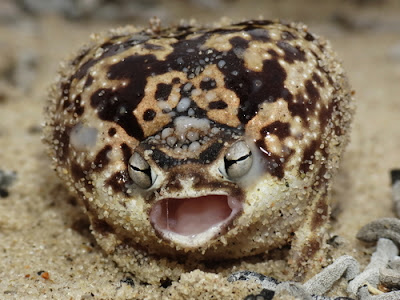
One of the classic textbook examples of the difference between toads and frogs, including skin texture, is that obviously frogs live near water and toads live more inland than their more lovable cousins. The rain frogs read this textbook, promptly put it down, and with a smug look, said "Nope".

None of the pictures provided belong to the author.

Look at that smug bastard's face. He's breaking all the stereotypes.
Honestly, the more you look at them, the more ridiculous they get. They're practically the pugs of amphibians; ugly enough to be adorable. Their faces are smashed in, their legs are short and stumpy, and their skin is covered in little warts. And they're fat frogs too. Oh yah, they squeak as well.
Yes, rain frogs will actually squeak you into submission, sounding like a dying chew toy as they probably list off vulgar insults in their language. I also mentioned earlier that rain frogs aren't very water-loving. Quite a few species, such as the squeaky Namaqua rain frog above live right in the middle of the desert and scrub. Burrowing underground (where else?), they wait for rains to come, then emerge and devour insects. The Cape rain frog in the first picture, lives in fynbos, while others live on the savanna. Either way, most of them don't sit around in ponds like the frogs here in Illinois.

I leave you with this. Tomorrow, murderfrogs.
None of the pictures provided belong to the author.
Sunday, February 10, 2013
Wow I'm Inactive
Hopefully that will change. Meanwhile, in the midst of school and social life (yes, us blog-owners have one too; they're not substantial but it's a life), I've began my own project that will hopefully be finished by late summer or early fall:
 It's a little hard to read, due to not being able to stretch the image without turning this post into an ugly mess, but its a Batman story. Yah I know, a little untraditional for my blog, but oh well, I like Batman. Brenden Hall (TheFancyRaptor on Deviantart) will be illustrating.

Monday, December 31, 2012
Happy New Year!
I apologize for the sheer inactivity here - I didn't even come by to wish people a merry Christmas/happy Hanukkah/joyous Kwanzaa. Hopefully with the new year that'll all change. And now since 2013 is upon us, I find it perfectly acceptable to run down a list of this year's revolutionary discoveries.
 This year has provided several great discoveries of feathered dinosaurs. Shown to the right is Yutyrannus huali. There's an ongoing debate on its identity; some say it is a tyrannosauroid while others retaliate with the possibility of it being a carnosaur. Whether it be T. rex's granddaddy or some Chinese flesh-grazer, it weighs in at 3000lbs and is nearly 30ft long, making it the biggest dinosaur with known evidence of feathers. It proves that size doesn't necessarily correlate with the presence of feathers, being an Allosaurus-sized dinosaur. Next up on the chopping block is Sciurumimus albersdoerferi, an adorable little puffball with an almost impossible to remember specific name. Known from a juvenile originally called "Xaveropterus", Sciurumimus gave us a plot twist when it turned out not to be another compsognathid or even a coelurosaur, but actually a megalosauroid, showing that feathers weren't restricted to coelurosaurian theropods. Finally, the last outstanding feathered discovery was discovered in North America AND it was a known genus...

Ornithomimus, portrayed at the left, has long been thought to have feathers, as well as its comrades. Only now do we have proof. A new study described this year showed that several fossils of different ages had plumaceous feathers, and that only the adults had wings, perhaps for display.
South America has been a treasure trove for unusual species in the past. The largest known dinosaur Puertasaurus reuili was discovered there, as well as many other sauropod giants such as Argentinosaurus huinculensis, Futalognkosaurus dukei and"Antarctosaurus" giganteus. Theropod giants weren't excluded either, including massive carcharodontosaurs like Giganotosaurus carolinii, Mapusaurus roseae, and Tyrannotitan chubutensis, as well as the industrial-sized abelisaur Ekrixinatosaurus novasi. However, not much seems to have been uncovered in the way of non-dinosaurian giants. Sure, we know giant crocodiles, phorusrhacids, and mammals ruled the land after the non-avian dinosaurs died out, but what about during their reign? The new Aerotitan sudamericanus clears some way for (somewhat) terrestrial giants. An azhdarchid, this new pterosaur had a wingspan of at least five meters, comparable to the more aerial sea-feeding pterosaurs found in Brazil. Now you can jsut picture it invading a titanosaur's nest site, swallowing eggs and snapping up juveniles.
 Speaking of South American giants, remember Titanoboa cerrejonensis? It turns out this megasnake wasn't the only giant reptile on the block. Unearthed this year was the turtle Carbonemys cofrinii, an immense giant with a shell nearly 6ft long. Though this isn't half as long as the later giant turtle Stupendemys souzai, it is still nonetheless an impressive beast, and if anything like the modern day snapping turtle, a force to be reckoned with.
 Giant reptiles seem to be rather commonplace this year. This time however, we go to the extreme north of the island of Svalbard to find our next example. "Predator X" has been known since 2008, even starring in the documentary Planet Dinosaur, but only this year was its name revealed: Pliosaurus funkei, the sixth species of Pliosaurus. Whether or not its specific name is actually pronounced as "funky" is unknown to me, but it was definitely a giant at approx. 42ft long.
Another European native has also shocked us this year, but not by size, appearance, or biological weaponry (such as the disproven venomous Sinornithosaurus), but by its choice of habitat. The recently discovered mosasaur Pannoniasaurus inexpectatus is aptly named because nobody expected it to live in not saltwater, but freshwater. While other mosasaurs, such as Goronyosaurus, could have inhabited brackish water and one specimen of Plioplatecarpus (if I recall correctly) seems to have stranded into freshwater, Pannoniasaurus is the only one currently known to have lived its entire life in rivers and lakes. Some have suggested it as a sort of reptilian river dolphin, but I picture it more as a crocodile. And speaking of crocodiles...
 Crocodilians of immense size seem to be a staple throughout history. Deinosuchus is immensely covered, perhaps not as much as Sarcosuchus however. Both suffer from anachronism and misplacement, the former often depicted with T. rex (wrong time, wrong place) and the latter depicted alongside Spinosaurus (once again, wrong time and wrong place). Less famous are the giant crocs of the Cenozoic and the stomatosuchids of the Cretaceous. One of our more recent crocodilians to be discovered falls under the category of Cenozoic giants. Crocodylus thorbjarnarsoni lived in Kenya from approx. 4-2mya and was longer than a pickup truck at 25ft in length, about as big as the biggest estuarine crocodiles today. What makes this monster even worse is that it may have preyed on early hominins such as Paranthropus.
Also joining the trend of large African crocodilians is Aegisuchus witmeri, the so-called "shieldcroc" shown to the above right. So far, no one has really come to a conclusion with estimates from the skull size sporadically ranging from a total length of 30-70ft. Though it appears similar to the aforementioned stomatosuchids, it is actually a member of the small family Aegyptosuchidae. No matter what estimate you go by, this was clearly a huge crocodile, possibly one of the largest in history.
 Dinosaurs are probably the driving point of palaeontology, one of the most researched fields and the most attractive to the general public. As mentioned above, there have been plenty of new dinosaurs and new studies this year; so many that not each can gain its own paragraph. We now know more about the diet of Sinocalliopteryx gigas (shown at left), and we know that Microraptor zhaioanus exhibited dark iridescent plumage, similar to modern-day grackles. "Centrosaurus" brinkmani was reassigned to its own genus Coronosaurus brinkmani, and along with the pygmy Gryphoceratops and the larger Unescoceratops, as well as Pachyrhinosaurus perotorum and Xenoceratops, added to the ever-growing diversity of ceratopsians. Dinosaurs have been named after Sauron (Sauroniops), while others haven't gained the best names (Bicentenaria argentina). We have Jurassic abelisaurs and spinosaurs (Eoabelisaurus and Ostafrikasaurus, respectively), a comparatively complete Asian spinosaur (Ichthyovenator), another new Morrison Formation sauropod (Kaatedocus), a lover of the hunt (Philovenator), and a strong-jawed heterodontosaur rediscovered in a museum collection (Pegomastax). And it even looks like dinosaurs might have stretched back to nearly 245mya, if the reexamined Nyasasaurus proves to be one (alternatively a dinosauromorph, such as a silesaurid).
There are many, many, many more new discoveries we could cover, but I think it's fitting to draw it to an end here. Happy New Year! Credits for artwork below.
------------------------------------------------------------------------------------------------
Ornithomimus - © Julius Csotonyi
Carbonemys - © Liz Bradford
Pliosaurus - © Raul Martin
Aegisuchus - © Henry Tsai
Sinocalliopteryx - © Julio Lacerda
 This year has provided several great discoveries of feathered dinosaurs. Shown to the right is Yutyrannus huali. There's an ongoing debate on its identity; some say it is a tyrannosauroid while others retaliate with the possibility of it being a carnosaur. Whether it be T. rex's granddaddy or some Chinese flesh-grazer, it weighs in at 3000lbs and is nearly 30ft long, making it the biggest dinosaur with known evidence of feathers. It proves that size doesn't necessarily correlate with the presence of feathers, being an Allosaurus-sized dinosaur. Next up on the chopping block is Sciurumimus albersdoerferi, an adorable little puffball with an almost impossible to remember specific name. Known from a juvenile originally called "Xaveropterus", Sciurumimus gave us a plot twist when it turned out not to be another compsognathid or even a coelurosaur, but actually a megalosauroid, showing that feathers weren't restricted to coelurosaurian theropods. Finally, the last outstanding feathered discovery was discovered in North America AND it was a known genus...


Ornithomimus, portrayed at the left, has long been thought to have feathers, as well as its comrades. Only now do we have proof. A new study described this year showed that several fossils of different ages had plumaceous feathers, and that only the adults had wings, perhaps for display.
South America has been a treasure trove for unusual species in the past. The largest known dinosaur Puertasaurus reuili was discovered there, as well as many other sauropod giants such as Argentinosaurus huinculensis, Futalognkosaurus dukei and"Antarctosaurus" giganteus. Theropod giants weren't excluded either, including massive carcharodontosaurs like Giganotosaurus carolinii, Mapusaurus roseae, and Tyrannotitan chubutensis, as well as the industrial-sized abelisaur Ekrixinatosaurus novasi. However, not much seems to have been uncovered in the way of non-dinosaurian giants. Sure, we know giant crocodiles, phorusrhacids, and mammals ruled the land after the non-avian dinosaurs died out, but what about during their reign? The new Aerotitan sudamericanus clears some way for (somewhat) terrestrial giants. An azhdarchid, this new pterosaur had a wingspan of at least five meters, comparable to the more aerial sea-feeding pterosaurs found in Brazil. Now you can jsut picture it invading a titanosaur's nest site, swallowing eggs and snapping up juveniles.


Another European native has also shocked us this year, but not by size, appearance, or biological weaponry (such as the disproven venomous Sinornithosaurus), but by its choice of habitat. The recently discovered mosasaur Pannoniasaurus inexpectatus is aptly named because nobody expected it to live in not saltwater, but freshwater. While other mosasaurs, such as Goronyosaurus, could have inhabited brackish water and one specimen of Plioplatecarpus (if I recall correctly) seems to have stranded into freshwater, Pannoniasaurus is the only one currently known to have lived its entire life in rivers and lakes. Some have suggested it as a sort of reptilian river dolphin, but I picture it more as a crocodile. And speaking of crocodiles...

Also joining the trend of large African crocodilians is Aegisuchus witmeri, the so-called "shieldcroc" shown to the above right. So far, no one has really come to a conclusion with estimates from the skull size sporadically ranging from a total length of 30-70ft. Though it appears similar to the aforementioned stomatosuchids, it is actually a member of the small family Aegyptosuchidae. No matter what estimate you go by, this was clearly a huge crocodile, possibly one of the largest in history.

There are many, many, many more new discoveries we could cover, but I think it's fitting to draw it to an end here. Happy New Year! Credits for artwork below.
------------------------------------------------------------------------------------------------
Yutyrannus - ©DeviantART user pilsator
Ornithomimus - © Julius Csotonyi
Carbonemys - © Liz Bradford
Pliosaurus - © Raul Martin
Aegisuchus - © Henry Tsai
Sinocalliopteryx - © Julio Lacerda
Saturday, October 6, 2012
T. rex's Birthday, A Strong Jaw, and Giant Reptiles
Luckily, I'm only a couple of days late with this one. Recently, Paul Sereno described Pegomastax africanus (which is a pretty cool name) from remains brought from the Africa in the 1960's. Sereno struck it as odd in the 1980's, and described the dinosaur a few days ago. Only 2ft long, it was about as large as the later Fruitadens of Colorado. It had a robust lower jaw and canines, like most other heterodontosaurids. Even better, we have new art from both Tyler Keillor and Todd Marshall to tag along with it. I actually knew about Tyler Keillor's sculpture awhile ago, though I only knew it as a "primitive ornithischian".


Todd Marshall

Tyler Keillor
Meanwhile, yesterday was T. rex's 107th birthday. I would have posted about it sooner, but wasn't around a computer almost all day.

Julius Csotonyi
Yesterday, one of the places we went was Serpent Safari in the Gurnee Mills mall. Here's some photos from my phone (excuse poor quality, it IS a phone camera).

I hate to jump on the train in saying that reptiles are practically like dinosaurs, but my God, this snapping turtle is just too huge and old to resist. The turtle has to be at least 5ft long, is 30.5in in diameter, and is more than 150 years old. You can see a bullethole in the shell; when they found the turtle, the bullet dated back to the Civil War. Given its monstrous size (the shell alone is longer than my arm), I'd believe it.

A green iguana breaks all the rules by being fire-orange-red. The tour guide said it could have taken decades to achieve this colour through selective breeding.

I absolutely love turtles; especially the freshwater ones. Fly River turtles (or pig-nosed turtles) are definitely my favorite and this little one was pretty photogenic.

The world's largest living python is shown here; nearly 26ft long and 395lbs. The biggest one ever was 401lbs. This small menagerie of reptiles also had a Nile crocodile, a lavender tiger reticulated python, an albino and normal alligator, two more pythons, a tegu, and several monitor lizards; those pictures didn't turn out as well.
Subscribe to:
Posts (Atom)