Welcome to a blog now shared by one, two, um... four people. Wipe your shoes off on the mat and delve into the posts featuring rants, museum pictures, and some cool facts. Nerds of all kinds welcome.

Friday, February 10, 2012

C-Rex's Art of the Week 2

Well, I guessed I sort of missed last week, so we'll trawl up some drawings from then too.

Some very specific tyrannosaurs; Jane, the feathered rex at the bottom chewing on her contemporary Homer, the Rockford Triceratops; Sue, the largest of the tyrannosaurs pictured; Stan the second from the back starting to develop his mature feathers; and the Devil T. rex with a healthy mane of an adult male. Probably my favorite drawing I've done in a while.


Top to bottom: Triceratops horridus, Centrosaurus apertus, Zuniceratops christopheri, and Coahuilaceratops magnucerna. Done at school.

A baby Deinonychus antirrhopus finds himself prey to a raptor's nightmare; a fatal infestation of mites. Based on bird mites.

Saturday, February 4, 2012

Paleo Interview 2: Tyler Keillor

Recently, I emailed another artist I knew, one who does sculptures, by the name of Tyler Keillor. Tyler is a great guy who I've been able to talk to (in person this time) a couple times, once at my "local" museum, then again at another museum in Lake County. We've been able to keep in touch through email ever since then, and I usually keep him updated on my art, just like he keeps me updated on his.


One of Keillor's most recent sculptures portrays Dryptosaurus. With feathers too!

1. When did you first get interested in dinosaurs?
I can remember watching the original "Land of the Lost"  TV show in the 70's, when I was maybe 3 or 4 years old.  For those who have never seen it, it had dinosaurs created both with stop-motion animation and hand puppets in other shots. Totally cheesy by today's standards; but to a little kid back then it was awesome.  I also saw "The Last Dinosaur" on TV at about that time, a man-in-rubber-suit dinosaur movie that really captivated me at a young age.  Living near Chicago, I was also fortunate to have been taken to the Field Museum on many occasions, where my main objective was always to see the dinosaurs, mummies, and shrunken heads!  At a very early age - again 3 or 4 - I started trying to draw dinosaurs and monsters ( they went hand-in-hand in my mind, especially the dinosaur-like kaiju, or Japanese monsters, that I saw in shows like Specterman, Space Giants, Giant Robot, and Godzilla and Gamera films).

2. Do you ever draw inspiration from real life or other paleoartists in your sculptures?
I have to say that part of the reason I'm in this line of work owes back to my childhood fascination with the Charles Knight murals at the Field Museum.  They used to sell postcards of these murals in the museum gift shop, and I would get these as souvenirs and study them back at home.  Every artist is in some ways inspired by those who blazed the path. I of course was influenced in my own early drawings and imaginings by Knight's work, and many of the other iconic artists whose work I also saw in old books we had lying around the house:  Rudolf Zallinger's murals, Zdenek Burian's copious paintings, even Rod Ruth's kids books and jigsaw puzzle paintings.  Today, I still admire and study the historic works of veteran paleoartists, and the new work by current and emerging artists.  I find it inspiring to see the great variety of styles and techniques used by artists today, and of course with paleoart there is so much room for an artist to put his or her own stamp of originality on a piece.  This is part of why I like to look to nature for inspiration: it allows a great deal of fascinating research in comparative anatomy, and the opportunity to find ways of adding reality-based details to speculative reconstructions. Starting with the real anatomy of a fossil, and bringing the creature back to life not by copying what other artists have done but by doing one's own research into why the animal may have looked a particular way, is for me a very rewarding part of the process.


3. Who is your favorite paleoartist?
I don't have a current favorite paleoartist, though I'm continually impressed by some of the artwork I see submitted in Prehistoric Times magazine.  I must say that I haven't spent a lot of time on Deviantart; however after your recent blog post interview with Julio Lacerda, I spent some time in his and several others' galleries, and again I'm thoroughly impressed (and motivated to up my own game!).  As I mentioned Charles Knight was probably my first favorite paleoartist, and then when I saw Zdenek Burian's work reproduced in books in my school library - especially some of his primitive man paintings - I thought I was looking at magical photographs of the ancient past!  So he was a favorite for a while, too. When I became serious about trying my own hand at paleoart, I immersed myself in the works of the current professional practitioners, and they've all inspired me for different reasons.


4. What is your favorite sculpture you've done?
I'm pretty excited about the most recent sculpture I've created, which as of this posting hasn't been unveiled yet...so I'm bound to not give it away yet!  I'll send you an update and some images as soon as this little ornithischian hits the press...
It's usually the case that my current project becomes my new favorite, as I try to incorporate all the tricks and techniques that I've used and developed on previous models in an effort to keep improving.  Looking back, one highlight was myRugops primus sculpture in 2004.  This was both my first life-sized flesh head, and also my first serious jump into comparative anatomical observations.  I spent a lot of time researching what the different areas of Rugops' face should look like, and this involved trips to the herpetology and ornithology collection areas at the Field Museum.  It was so exciting to compare the maxilla of Rugops and find similar textures on the skull of a cassowary - that guided my choice for creating the appearance of keratinous tissue, and was just the tip of the iceberg for many other extant observations. In retrospect I'd do a few things differently on the model today (such as the details of the oral margin), but I'm still happy with it.  TheNigersaurus skull reconstruction and flesh model were also very challenging and exciting projects to work on, and I'm happy with the results.  A funny thing about working with a deadline on these projects is that I never quite feel like I had enough time to really get it "right"; I think this is something most artists feel at times, when they're never quite satisfied with a piece, but still must call it "done" and move on to the next project.

Rugops in the big old outdoors.

An interesting view of Tyler's Nigersaurus, about to munch down on some plants. I've been able to view the sculpture before, revealing some interesting details; a keratinous mixture and pieces of foliage and saliva in its mouth.


5. What is your favorite piece of art another paleoartist has done?
Recently I was blown away by the life-sized Spinosaurus sculpture created in Italy by the team from Geomodel.  I don't know the artist(s) involved, but from the photos I've seen online, the model has a wonderfully natural scale pattern and coloration that I really love. A few other recent favorites include: David Krentz and team's digital creations for "Dinosaur Revolution",  Hall Train's mechanical walking T-rex skeleton, John Gurche's hominids, I could go on and on!


6. Has anyone in your life ever played a role in your art and sculptures, encouraged you to pursue it, etc?
Both of my parents played a big role in starting me off and encouraging my work. My mom is an artist, so I grew up assuming it was natural that you should always have supplies and materials and a work-space to make anything you could imagine.  When "The Dark Crystal" came out in 1982, my 10 year old mind was blown away - I was completely enamored by the artistry and creativity throughout that movie.  My mom sculpted elaborate paper mache figures of characters Aughra and a Skeksis for me (which I still have!) and these creations showed me that it was possible to render tangible the fantastical. My dad helped me make a Super 8mm silent dinosaur film when I was about the same age, using rubber toys from my collection, and even the Skeksis my mom had made (minus his robes) doubled as a theropod in one shot!  As I mentioned, movie monsters went hand-in-hand with dinosaurs for me, so my dad began to foster my interest in movie special effects by finding molding and casting supplies for me when I was in junior high school, and we would do experiments together like molding a hand with plaster and casting it in rubber.  My parents let me take over a section of their basement to set up a workshop, doing all kinds of crazy experiments and learning about materials and techniques by trial and error.  All of this laid the groundwork for the skills I would use in jobs to come. 


Much later, I received another major vote of support when I met John Lanzendorf.  If you've been to the Indianapolis Children's Museum, you may have seen his collection of Paleoart on display there in his own gallery.  Prior to this, that art collection occupied every available space in his Chicago apartment.  The Field Museum had a temporary exhibit with hisT-rex collection on display in 2000 (when Sue was unveiled). That's when I met John and we became friends.  I showed him some of my work, and he was so supportive and urged me to keep improving, to meet other paleoartists, to join the Society of Vertebrate Paleontology, to meet other paleontologists... he really opened a lot of doors for me, and for many other artists, as well, during that chapter of his life. (Incidentally, if you're interested in John and his collection there was a very nice book about it called "Dinosaur Imagery: the science of lost worlds and Jurassic art: the Lanzendorf collection").


I also have to thank some great paleoartists I've been fortunate to get to know more recently.  Mike Skrepnick, Gary Staab, Mark Hallett, and Donna Braginetz have all been very encouraging and supportive of my work, generous with advice, and sharing in information and shop-talk.


7. How long does it usually take to finish a sculpture? 
It can take a month or more to make one of my life-sized flesh-head sculptures.  If my job is to start by creating a skull restoration, that might take a month or more itself, and then the flesh model over top of it might take another similar period of time.  Sometimes I'll have more extensive pre-production time, when I'm making prototypes and collaborating with the researcher(s) on their discovery to determine what the final model should look like. Due to the uncertainties of reconstructing incomplete fossils while the paleontologists who found them are still actively cleaning and studying them, my work on Tiktaalik stretched on for about 6 months; my work on Sanajeh spanned about a year and a half! 

The Tiktaalik sculpture appears to have a smile.

Tyler's representation of Sanajeh is one of my favorite of his sculptures. This baby titanosaur is about to become a snack.


8. What details do you include on your sculptures and how do you do it?
The details I put on my models are attempts at replicating the textures, tissues, details that I observe in my comparative references.  For example, the keratin on top of Jane the juvenile tyrannosaur's snout is based in part upon a hornbill's cracked, weathering crest.  I work with clay, so I use a variety of tools to carve lines, create folds, imprint textures that I've peeled off of other surfaces, etc.  Then I go through the molding and casting process so that I can make durable, lightweight copies of the original clay model.  After I've painted the cast, I have another opportunity to add details:  strands of saliva within the mouth, bits of chopped vegetation in an herbivores mouth or chunks of "meat" lodged between the teeth of theropods, dirty peeling scabs, whatever else I can think of to give the creature a bit of life.  I like to experiment with new materials (resins, rubbers, etc.) to figure out ways of recreating surfaces and textures I see in nature.

9.  Anything you would like to say to anyone interested in dinosaurs or art?
I just think it's worth reminding ourselves how lucky we are to live at a time when dinosaur discoveries are being made all over the world at a record pace, research and technology is allowing a greater understanding of ancient life than ever before, and we have so many capable artists out there giving us wonderful glimpses of these amazing creatures.  For anyone who wants to learn more or try creating some paleoart themselves, there is just no shortage of interesting subjects, or inspiring artists to look up to and learn from.

---------------------------------------------------------------------------------------------

For anyone interested in more of Tyler's work, visit his website:


Or watch his Youtube channel:

Jane the Rockford T. rex, whom I will see in March, would like to say bye.

An Observation on T. rex

Not that I just found this out, but it is something I noticed; T. rex must have hunted some of the most dangerous prey ever.

-The main two ceratopsians of Hell Creek, Triceratops horridus and Torosaurus latus, each must have weighed anywhere from 5-12 tons in weight, and were armed with three horns that could prove some damage, even when its impossible for them to charge without killing themselves. They also possessed crocodilian-like armour on their flanks and might have had quills as well, which may have been used for defensive measures like porcupines. They also had bone-crunching beaks suitable for snapping more than tough plants. The other ceratopsian, Leptoceratops gracilis, could prove a threat to young tyrannosaurs, with a large bite force, omnivorous diet, and possible quills too.

-The most common ornithopod at Hell Creek, Edmontosaurus annectens, could have weighed as much as T. rex, if not more, and a stampeding herd could easily crush the predator. I can picture subadults also bucking up and kicking like horses; if that's impossible, tell me so. Thescelosaurus neglectus could only pose a small threat, possibly even to young tyrannosaurs. Might have kicked and had quills.

-The other three known marginocephalians at Hell Creek are Pachycephalosaurus wyomingensis, Sphaerotholus buchholtzae and Stygimoloch spinifer (which I consider "Dracorex" as the juvenile form of). The latter two were only eight feet long at the most, but could have easily injured a juvenile tyrannosaur, using their domed heads and spikes to ward one off. The former genus is the largest pachycephalosaur known, with the largest forms around 20-25ft long, putting it in the same length class as Torosaurus. At this size, it could still pose a threat to a hunting tyrannosaur, probably capable of breaking some bones.

-More ornithischians are found in T. rex's range. These are the ankylosaurians, and the most famous is the widely-built Ankylosaurus magniventris, and it was nearly 30-35ft long and 13,000lb in weight. With thick armor, a clubbed tail (around 100lb, if I recall correctly), and ferocious tenacity, it would have been one of the hardest prey items available. Edmontonia schlessmani is found in T. rex's range as well, and although smaller than Ankylosaurus (20-25ft), it was armored, with well, armor, that included very long, sharp, shoulder spikes that would easily gore an attacker's skin.

-We usually don't think of theropods hunting other theropods, and think of them going after herbivorous creatures, but several theropod species were possibly prey of young tyrannosaurs. Struthiomimus sedens, 12-16ft long, would have been one of these, and it was built like an ostrich. Sadly, many people portray them, as well as duckbills, completely harmless, but this couldn't be the case. Like I said, built like an ostrich. Ostriches, and their much more dangerous cousin, cassowaries, can easily kill with one kick; Cracked.com states the ostrich kicking with the force of "2.5 Mike Tysons". An ostrich is on average around 215lbs, and when you scale it up onto a 330lb dinosaur, the damage won't be pretty.

-The other theropods that are possibly tyrannosaur prey are odd creatures; the oviraptorosaurs. Chirostenotes elegans was a 6-8ft long creature and could have kicked like an ostrich as well. I don't know much about the head strength of oviraptorosaurs, but they might have been able to bite pretty hard as well and ram with their crests, as well claw with their arms. The Triebold caegnathid, unnamed at the moment, was twice the size of the largest Chirostenotes, and would have posed even more of a threat.

-One more saurischian could have possible prey for T. rex, albeit not at Hell Creek, and a T. rex would have to be suicidal to attempt to hunt it alone. Alamosaurus sanjuanensis is the largest dinosaur known from North America (besides the extremely fragmentary Amphicoelias) and was Argentinosaurus-sized, placing it at 80-90 tons. T. rex would have had to hunt in packs to bring an adult down, and even then, it was still a danger.

Sunday, January 29, 2012

Prehistoric Times

My drawing, titled 'Tug of War':


Will be featured in issue #101 of Prehistoric Times in the spring! I can't wait to see it!

Paleo Interview 1: Julio Lacerda

Recently, I sat down (well, on my swivel chair that is) and was able to speak to Julio Lacerda through Deviantart. Lacerda is an aspiring artist, 18 years old, and a self-described "casual paleoartist".

Lacerda's latest piece features Baryonyx (or Suchomimus) tenerensis in a algae-infested pond. 


Wanting to do interviews for my blogs too, I knew I could easily contact Lacerda, as we have spoke before and he is a friendly guy. He answered all my questions rather quickly to my delight (me in bold).

-------------------------------------------------------------------------
1. When did you first get interested in dinosaurs?
I've always been interested in all kinds of animals, so when I first heard of dinosaurs as a little kid it was love at first sight. I can't remember if my first contact with them was through school or some documentary, but since then I've been drawing dinosaurs and reading about them as much as I can. The enormous amount of new information we acquired in the last decade only made this interest greater. 

2. Do you ever draw inspiration from real life or other paleoartists in your art?
Although I look at a lot of animal photographs to get idea for colours, shapes, behaviours and the overall 'feeling' of a living creature, I also look at the reconstructions of other paleoartists, especially those that are up-to-date to help me visualize what I'll be doing. Before every illustration I always do some research about the subject. 

3. Who is your favorite paleoartist?
 Looking at the work of various paleoartists helped me find the style that suited me the most. One of the first whose work I knew was John Sibbick, who I think was my favourite during most of my childhood. Then I stumbled upon the Greg Paul dinosaurs; he always showed them as complex animals in a way few paleoartists had done before, all the whille with great artistic skills. But nowadays, I can cite Douglas Henderson and John Conway as some of my favourites, since the work of those two had a major role in making me find out what I like and what I don't like in paleoart. 

4. What is your favorite piece of art you've done?
That's a tough question.. My first image uploaded online, wich I entitled "Diplodocus Parade", though inferior now compared to my newer ones, still has a very special place in my heart. The Gorgosaurus pair I made earlier this month was also very important, for it achieved the biggest response among the public until now. But recently, all my illustrations are kind of favourites in their own right.

 Diplodocus Parade entered my spectrum of favorites and once inspired me to draw something similar.
Lacerda's piece titled "Royal Wedding" features the Arctic Prince, another illustration of his, finding his princess; he said it was based on a photo of Japanese cranes. It was featured recently on popular blog "Love In The Time of Chasmosaurus", an honor some of us dream about.

5. What is your favorite piece of art another paleoartist has done?
I can't think of any specific piece of art from other paleoartist that I can call my favourite, but I'm fascinated by the John Conway's pterosaur illustrations, the environmental scenes of Douglas Henderson, the waterscapes of Andrey Atuchin and many, many others. 

6. Has anyone in your life ever played a role in your art, encouraged you to pursue it, etc?
My mother has always been a very important person to me in this respect. She's also an artist, although her style and interests are very different from mine, and she always encouraged me to follow my artistic 'self'. If I ever become successful doing this, I guess she's the biggest responsible. 

7. What do you think of The Paleo Handbook so far?
I loved the Idea of the Paleo Handbook. Everybody who likes dinosaurs and other prehistoric creatures undoubtedly has thought about writing a detailed description of them, just like the many animal profiles on books, encyclopedias, the internet etc. So when I found a place where this was being done, using the latest paleontological discoveries and a healthy dose of speculation, I was definetely happy to join. 

8. How long does it usually take to finish your art?
Many people call me fast, because I finish most of my illustrations usually in less than 12 hours, sometimes less than 6 hours is enough. That's only possible because when I decide to sit down and paint something, I only stop to sleep and eat, otherwise I kind of lose interest in it and the illustrations gets abandoned, half-done in some folder. I have a couple dozens of WIPs that I'll probably never get around to finish, unfortunately.

Lacerda's Quetzalcoatlus looks almost photographic.

9. Anything you would like to say to anyone interested in dinosaurs or art?
I would recommend every young artist to think of dinosaurs as fascinating animals, just like the ones we have around today, instead of monsters that go aroung roaring all the time. There's nothing wrong in liking Godzilla-like theropods and use them in action stories just like Jurassic Park did, but the paleoartistic community is really lacking people who take them seriously. If you want to be recognized as a great paleoartist, I think that is definitely the path you should take.
----------------------------------------------------------------------------------------------------
And that wraps up a great interview with a great person. I recommend checking out Lacerda's blog:

And his Deviantart page:

And the Paleo Handbook, co-run (?) by me:

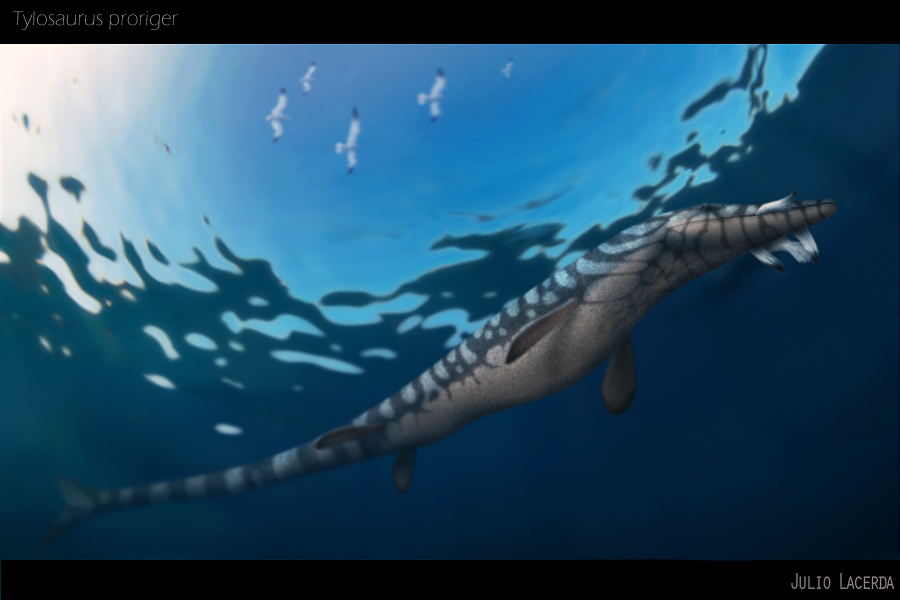
Tylosaurus says bye.

Saturday, January 28, 2012

Inside the World of Dinosaurs

You might have to hover to find the link:

Click here
Has anyone seen this? This is seriously awesome. "Inside the World of Dinosaurs" is an IPad app, a comprehensive and interactive digital encyclopaedia featuring 60 dinosaurs on 200 pages of content narrated by Stephen Fry. I seriously wish I had an IPad right now.

The News

Recently, not too much stuff has made the news in the paleontological field, but I'll try my best to find some links.

Click here
The oldest known dinosaur nest is unearthed, belonging to a family of Massospondylus.

Click here
Archaeopteryx was at least partially black in colouration.

Click here
The Miller's grizzled langur is rediscovered in Borneo.

C-Rex's Art of the Week

Welcome to my blog, Domain of the C-Rex. Today, we start in the earliest hours of Saturday with my art of the week, all drawn by yours truly. I'm no Rey or Stout, mind you, but hopefully you'll like them.

Silvisaurus condrayi among Dakota Formation residents; troodonts, "hypsilophodonts", dromaeosaurs, and pterodactyloids.


The expression on his face says it all "The thagomizers do the talking". Loricatosaurus priscus.


Stygimoloch spinifer crushes the light frame of Saurornitholestes sp, who screams its last words in its raptor language, "I'll see you in Hell...Creek!" Her mate loses his footing while Avisaurus archibaldi, Didelphodon vorax, and Thescelosaurus neglectus flee.


The noble simurgh and it's not so noble baby.


That's all I have for now, but check back later!